Cacio e Pepe
Not rated yet. Be the first.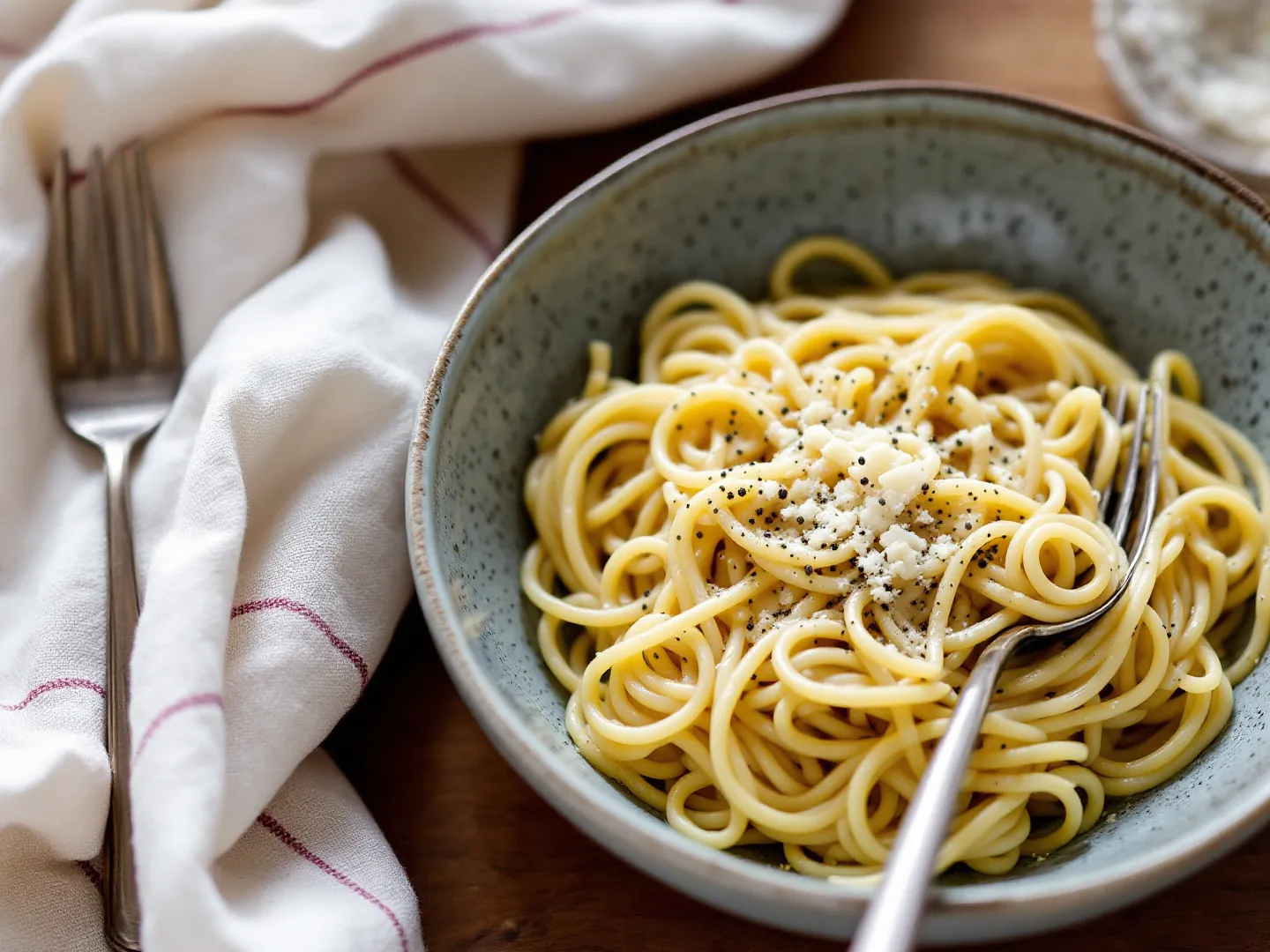
Pepper toasts in butter until the kitchen smells warm and sharp. The cheese goes in off the heat, a handful at a time, and the starchy water turns it silky. No cream, and nobody at the table misses it.
The short version
Toast the pepper in butter, cook the spaghetti in less water, then toss it off the heat with starchy water and finely grated Pecorino, a handful at a time. 25 minutes, and the cheese must be fine and the pan not too hot.
What makes ours better
what we fixed so you don’t have to
-
Toast the pepper in butter. Warm fat pulls the oils out of freshly cracked pepper and spreads them through the sauce, so the heat is warm and rounded instead of dusty.
-
Cook the pasta in less water. A smaller pot makes the cooking water cloudy with starch, and starch is what holds cheese and water together as a sauce. Don't use the water from a huge pot.
-
Add the cheese off the heat, bit by bit. Pecorino turns stringy and clumps when it gets too hot or hits hot water all at once. Letting the pan cool and adding it by handfuls melts it into a smooth sauce.
What you need
the usual suspects
- Spaghetti or tonnarelli12 ounces
- Unsalted butter2 tablespoons
- Olive oil1 tablespoon
- Pecorino Romano6 ounces
read it twice. buy it once.
Steps
deep breath. you’ve got this.
-
Grate the cheese
Grate the Pecorino as finely as you can, on the smallest holes of a box grater or a rasp, into a bowl. It should look like fluffy snow. Leave it at room temperature while you cook.
Skip pre-grated cheese. It has anti-caking powder that stops it melting smoothly.
-
Boil the pasta
Bring 2½ quarts of water to a boil in a large pot with the salt. Add the spaghetti and cook, stirring, until just short of al dente, 1 to 2 minutes less than the package says. Scoop out 1½ cups of the pasta water before you drain.
Use this smaller amount of water, not a giant pot. You want it to be cloudy.
About 8 min. Cook mode has a timer for this step.
-
Toast the pepper
While the pasta cooks, melt the butter with the oil in a large, wide skillet over medium heat. Add the pepper and cook, swirling, for about 1 minute until it smells toasty. Pour in ¾ cup of the hot pasta water and bring it to a simmer.
-
Finish the pasta in the pan
Use tongs to move the pasta straight from the pot into the skillet, with whatever water clings to it. Simmer for about a minute, tossing, until the water is reduced by about half and the pasta is almost tender.
-
Add the cheese
Take the skillet off the heat and let it sit for 30 seconds. Sprinkle in about a third of the Pecorino, then stir and toss fast with tongs. Add another third and repeat, then the last, adding a splash of pasta water if the sauce looks tight. It should turn creamy within a minute.
If it clumps, add 2 tablespoons of hot pasta water and keep stirring off the heat. It usually smooths out.
-
Serve right away
Taste, add more pepper if you like, and divide into warm bowls. Cacio e pepe thickens fast as it cools, so serve it the moment it's ready, with a spoonful of water over it if it tightens on the plate.
Good to know
the stuff I’d tell you over the phone
- Parmesan is milder and melts more easily. If your sauce keeps clumping, use half Pecorino and half Parmesan. It's less sharp but more forgiving.
- Crack the pepper coarsely, with a mortar and pestle or the bottom of a heavy pan. Fine pre-ground pepper tastes flat.
- For a looser sauce, use more water. For a thicker one, use less.
- Storage. Best eaten right away. Leftovers keep in the fridge for 2 days, but the sauce gets tight. Reheat in a skillet with 2 to 3 tablespoons of water over low heat.
Questions, answered
the questions my cousins text me
Why did my cacio e pepe clump?
The pan was too hot, the cheese went in all at once, or the cheese was coarse or pre-grated. Take the pan off the heat, grate the cheese very fine, and add it in three batches while stirring.
Can I use Parmesan instead of Pecorino Romano?
Yes, but it won't taste like the classic. Parmesan is milder and nuttier. Half and half is a good compromise.
Do I need to add butter?
Traditional versions don't use it, but a tablespoon or two makes the sauce silkier and more stable. We toast the pepper in it, and it helps prevent clumping.
How much pasta water should I use?
Start with ¾ cup in the pan and keep another ¾ cup nearby. You can always add more but can't take it out.
Can I make it for more people?
Scale the pasta and cheese together, but cook it in batches of no more than 12 ounces of pasta in a pan. A crowded pan cools unevenly and clumps.
From the table
Made it? Tell me everything. Especially if somebody said it was better than their mother’s. I’ll keep your secret.
Made it?
one star means we talk. five means I tell Dad.
Tap a star
- No reviews yet. Yours would be the first, and I’d read it twice.
Find it in
Published October 29, 2026.