Breakfast / Muffins & quick breads
Overnight English Muffins
Not rated yet. Be the first.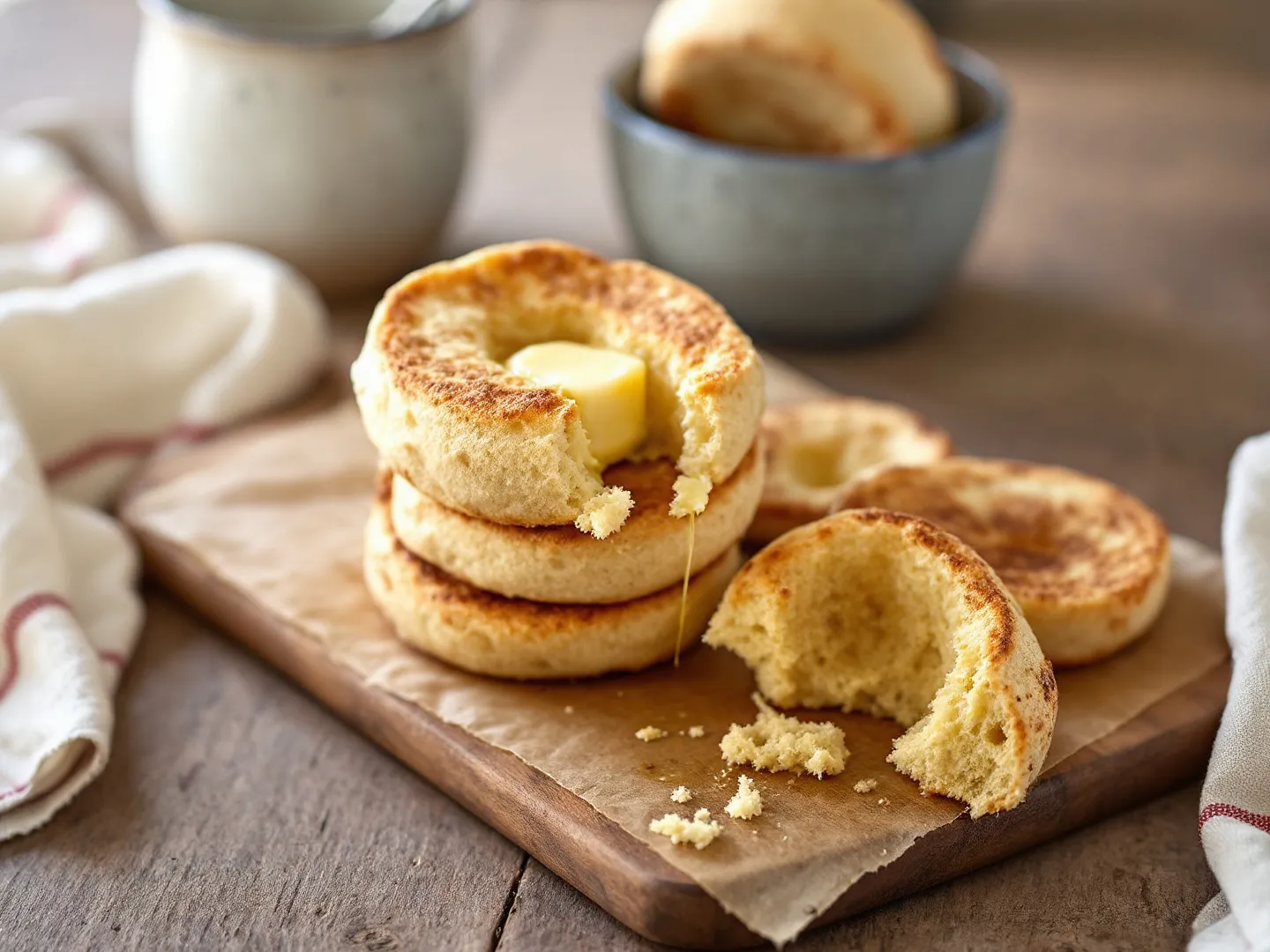
Stir the dough the night before, and in the morning the griddle does the rest. Split them with two forks, toast them, and let the butter sink into every craggy hole while the dog takes up his post by your feet.
The short version
Stir a wet buttermilk dough, let it rise 1 hour or overnight in the fridge, scoop it onto cornmeal and cook it on a low griddle, about 5 minutes a side. Split with forks, not a knife, and toast. Total hands-on time is under 30 minutes.
What makes ours better
why ours wins the argument at dinner
-
Let the dough rise overnight in the fridge. A slow, cold rise builds a tangy, yeasty flavor you can't get in an hour on the counter. It also means breakfast takes only the cooking time in the morning.
-
Keep the dough wet and scoop it. A sticky dough has no kneading and no cutter. The extra water turns to steam in the skillet and opens up the big holes.
-
Cook low and slow. Five minutes on the first side over low heat lets the muffin rise tall before it browns. High heat gives you a dark crust and a raw middle.
-
Split with two forks. A knife slices through the holes. Forks tear along them, so the toasted halves are all peaks and valleys for butter.
What you need
the stars of the show
- All-purpose flour2 cups
- Sugar1 tablespoon
- Active dry yeast1½ teaspoons
- Buttermilk1⅓ cups
- Unsalted butter2 tablespoons
- Coarse cornmeal½ cup
tap each one as it goes in. no double-salting.
Steps
apron on. phone down. mostly.
-
Mix the dough
Stir the flours, sugar, salt and yeast together in a large bowl. Warm the buttermilk until it feels barely warm on your wrist, then whisk in the melted butter. Pour it over the flour and stir with a sturdy spoon until no dry flour remains. The dough will be wet, sticky and shaggy.
If the buttermilk is hot, it will kill the yeast. Lukewarm means it feels like nothing on your skin.
-
Let it rise
Cover the bowl and leave it at room temperature until puffy and bubbling, about 1 hour. For the best flavor, refrigerate it instead for 8 to 12 hours, up to overnight.
About 60 min. Cook mode has a timer for this step.
-
Scoop onto cornmeal
Spread about half the cornmeal on a rimmed baking sheet. Using a ¼-cup measure or a large spoon, scoop 12 mounds onto it, leaving space between them. Don't stir or deflate the dough first. Sprinkle the tops with the rest of the cornmeal. They'll flatten a little on their own.
Wet your measuring cup first and the dough slides out instead of clinging.
-
Cook the first side, low and slow
Heat a cast-iron skillet or griddle over medium-low until warm, not hot. Lift in as many muffins as fit without touching, usually 4. Cook the first side for about 5 minutes without letting it brown; they will puff up. Raise the heat a notch and cook until the underside is deep golden, another 3 to 4 minutes.
About 8 min. Cook mode has a timer for this step.
-
Flip and finish
Flip the muffins and cook the second side until golden brown, 5 to 6 minutes more. Both sides should be browned and the sides should feel firm when you press them. Move to a rack. Let the pan cool for a few minutes, wipe out the loose cornmeal, then cook the next batch.
If a muffin feels doughy at the edge, give it a few more minutes on low rather than turning up the heat.
About 6 min. Cook mode has a timer for this step.
-
Cool, split and toast
Let the muffins cool for at least 15 minutes. They finish cooking inside as they cool. To split, push the tines of two forks around the edge, then pry the halves apart. Toast the halves until crisp at the edges and butter them while hot.
About 15 min. Cook mode has a timer for this step.
Good to know
read this before somebody asks for seconds
- The dough is meant to be wet. Resist the urge to add flour, or the muffins turn dense and bready instead of craggy.
- No buttermilk? Stir 1 tablespoon of lemon juice into 1⅓ cups of whole milk, wait 5 minutes, and use that.
- For muffin rings, set greased 3-inch rings on the griddle and fill each with about ¼ cup of dough. The muffins come out round and a bit taller.
- Storage. Cooled muffins keep in a zip-top bag at room temperature for 3 days. Split and frozen, 3 months; toast straight from the freezer.
Questions, answered
asked and answered at the kitchen counter
Do I have to rise the dough overnight?
No. One hour at room temperature until puffy works. The overnight rise only adds flavor, and the cold dough is easier to scoop.
Why are my English muffins doughy inside?
The griddle was too hot, so the outside browned before the middle set. Cook over medium-low and give each side about 5 minutes. You can also finish them in a 350°F oven for 5 to 8 minutes.
Why don't mine have nooks and crannies?
Usually the dough was too dry or it was kneaded or stirred too much after rising. Keep it sticky and scoop it gently. Splitting with forks, not a knife, matters just as much.
Can I make them without a cast-iron skillet?
Yes. Any heavy skillet or electric griddle at about 325°F works. Nonstick is fine, but watch the heat since it runs hotter than it feels.
Can I use all all-purpose flour?
Yes. Use 2½ cups (310 g) all-purpose flour. The whole wheat adds a mild nuttiness but isn't needed.
Can I freeze the dough?
Freeze the cooked muffins instead. Split them first, and they toast straight from the freezer.
From the table
Made it? Tell me everything. Especially if somebody said it was better than their mother’s. I’ll keep your secret.
Made it?
stars first, story second. I read every one.
Tap a star
- No reviews yet. Yours would be the first, and I’d read it twice.
Find it in
Published October 28, 2026.