Sides / Potatoes & sweet potatoes
Crispy Potato Latkes
Not rated yet. Be the first.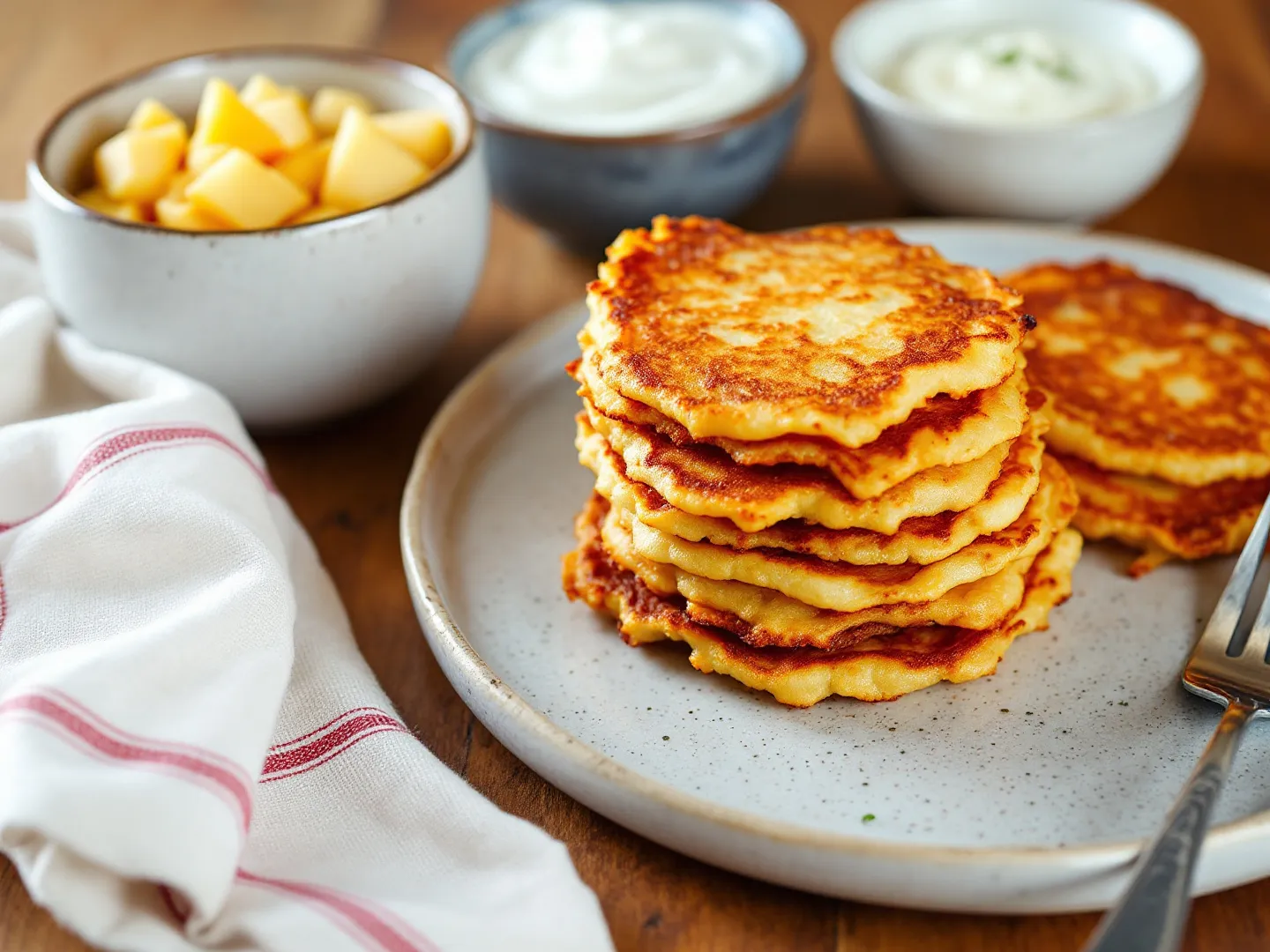
Every family has one person who eats latkes straight off the pan before they ever reach the rack. Squeeze the shreds dry, fry them hot and shallow, and you'll understand why.
The short version
Shred russets and an onion, squeeze them dry in a towel, then mix with egg, flour and salt. Fry spoonfuls in ¼ inch of hot oil, about 4 minutes a side, and hold them on a rack in a 250°F oven. The dry shreds are the whole secret.
What makes ours better
what we fixed so you don’t have to
-
Squeeze the shreds twice. Water is the enemy of crisp. A first wring in a towel gets most of it, and a second squeeze after the shreds sit for a minute gets the rest. Dry shreds fry; wet ones steam.
-
Keep the potato starch. Pour off the liquid from the squeeze and a layer of white starch settles at the bottom of the bowl. Stir it back into the potatoes and it acts as a natural binder, so you need very little flour.
-
Fry in shallow, hot oil. About ¼ inch of oil at a steady sizzle crisps the whole surface. Too little oil makes them greasy and pale, because they absorb it instead of searing.
-
Drain on a rack, not paper towels. Paper towels trap steam under the latkes and soften the bottoms. A wire rack over a sheet pan, in a low oven, keeps both sides crunchy.
What you need
the usual suspects
- Russet potatoes2 pounds
- Yellow onion1 medium
- Eggs2 large
- All-purpose flour or matzo meal3 tablespoons
tap each one as it goes in. no double-salting.
Steps
deep breath. you’ve got this.
-
Heat the oven, set a rack
Heat the oven to 250°F. Set a wire rack over a rimmed baking sheet. This is where finished latkes will wait.
-
Shred the potatoes and onion
Shred the potatoes and onion on the large holes of a box grater, or in a food processor with the shredding disk. Pile the shreds on a clean kitchen towel set over a large bowl.
Shred the onion first. Its acid keeps the potatoes from turning gray.
-
Squeeze out the water
Gather the towel around the shreds and twist hard over the bowl, wringing until only a few drops come out. Let the liquid stand for 2 minutes, then pour it off carefully and keep the white starch left at the bottom. Dump the shreds in the bowl on top of that starch.
About 2 min. Cook mode has a timer for this step.
-
Mix the batter
Add the eggs, flour, salt and pepper and toss with your hands or a fork until the shreds are evenly coated. The mixture will look loose and stringy, and that is right.
Mix right before frying. Salt pulls water out of the potatoes as it sits.
-
Heat the oil
Pour the oil into a large skillet, preferably cast iron, to a depth of about ¼ inch. Heat over medium-high until a shred dropped in sizzles right away and the oil shimmers.
-
Fry the first side
Scoop about ¼ cup of the mixture into your hand, squeeze out any liquid, and press it into a loose patty about 3 inches wide and ½ inch thick. Slide it into the oil. Fill the pan without crowding, leaving about an inch between latkes. Fry until the bottoms are deep golden brown, about 4 minutes.
If they brown too fast, drop the heat to medium. The middles should cook before the edges burn.
About 4 min. Cook mode has a timer for this step.
-
Flip and finish
Turn each latke once with a thin spatula and fry until the second side is golden and crisp, about 3 to 4 minutes more. Move to the rack, sprinkle with salt, and keep warm in the oven while you fry the rest. Add oil between batches as needed.
About 4 min. Cook mode has a timer for this step.
-
Serve right away
Serve hot, with applesauce and sour cream on the side.
Good to know
things I learned the hard way, so you can skip that part
- Russets are best. Their starch holds the latkes together and crisps beautifully. Yukon Golds work, but the latkes are a little softer.
- You can swap in a quarter of the potatoes for shredded parsnip, carrot or sweet potato. The latkes will brown faster, so watch the heat.
- Keep the oil clean by skimming loose shreds out between batches. Burnt bits turn the next batch bitter.
- Smaller latkes, about 2 inches across, are easier to flip and make good party food. Fry 2 to 3 minutes per side.
- Storage. Refrigerate cooked latkes up to 3 days. Freeze on a sheet pan, then bag them for 2 months. Reheat on a rack at 400°F for 8 to 10 minutes until sizzling and crisp; never in the microwave.
Questions, answered
the questions my cousins text me
Why are my latkes soggy?
Too much water in the shreds, oil that wasn't hot enough, or draining on paper towels. Wring the potatoes twice, fry at a steady sizzle, and rest the latkes on a wire rack.
Why are my latkes falling apart?
The mixture needs binder. Add back the starch that settled from the squeezed liquid, make sure you used enough egg and flour, and don't flip until the bottom is deeply golden and releases easily.
How do I keep latkes from turning gray?
Grate the onion first and mix it with the potatoes, then fry soon after. The onion's acid slows the browning. Avoid letting shredded potatoes sit for more than a few minutes.
Can I make latkes ahead?
Yes. Fry them, cool on a rack, and refrigerate. Reheat on a rack on a baking sheet at 400°F for 8 to 10 minutes. They crisp back up well.
Can I use a food processor?
Yes. Use the shredding disk for both the potatoes and onion. The shreds are a bit finer, and the latkes come out more tender and less lacy.
What oil is best for frying latkes?
Any neutral oil with a high smoke point, like canola, sunflower or peanut. Avoid olive oil, which burns at this heat.
From the table
Made it? Tell me everything. Especially if somebody said it was better than their mother’s. I’ll keep your secret.
Made it?
one star means we talk. five means I tell Dad.
Tap a star
- No reviews yet. Yours would be the first, and I’d read it twice.
Find it in
Published October 29, 2026.