Baking / Loaves & yeast breads
Buttery Brioche Loaf
Not rated yet. Be the first.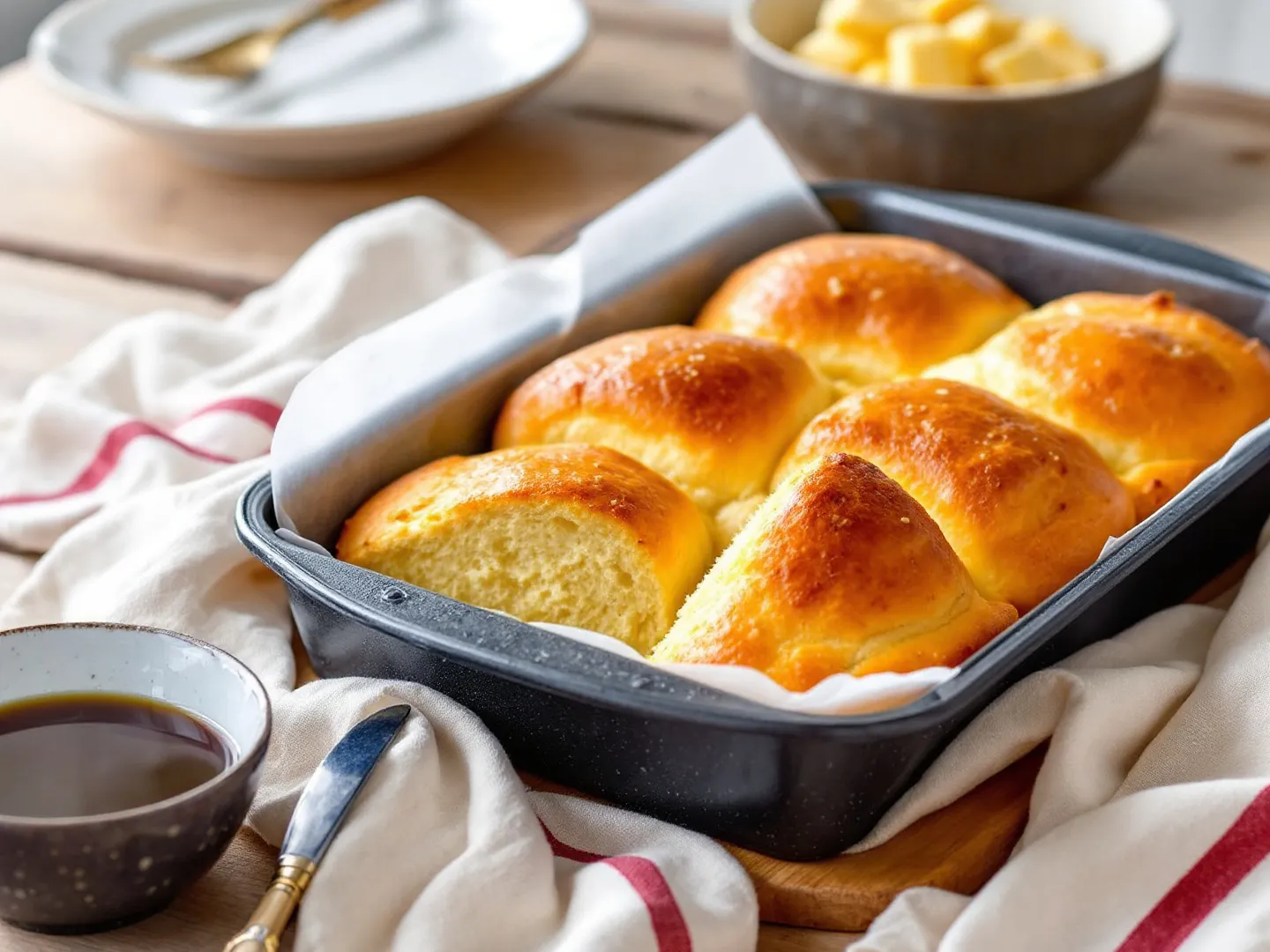
A stick and a half of butter goes in one spoonful at a time, then the dough sleeps in the fridge overnight. Next day it bakes as eight little balls in one loaf pan, glazed with egg yolk, and the house wakes up to the smell.
The short version
Mix a milk, egg and flour dough, knead it smooth, then beat in softened butter a spoonful at a time. Rise, chill overnight, shape into eight balls in a loaf pan, rise again and bake at 375°F for about 40 minutes. A stand mixer makes it easy.
What makes ours better
the tricks Nonna pretends she never taught me
-
Add the butter after the dough is kneaded. Developing the gluten first, then working in softened butter a spoonful at a time, gives a tall, silky crumb. Butter added too early coats the flour and the dough never builds structure.
-
Rise it overnight in the fridge. Cold dough is firm instead of sticky, so it shapes without extra flour, and the slow rise gives a richer, more buttery flavor.
-
Bake it as eight balls in a loaf pan. The sectioned loaf pulls apart in soft pieces and bakes evenly without any braiding or special molds.
-
Glaze with egg yolk. A yolk and a splash of milk brushed on before baking gives the deep, glossy mahogany top.
What you need
the cast, in order of appearance
- Whole milk⅓ cup
- Instant or active dry yeast2¼ teaspoons
- All-purpose flour2¼ cups
- Eggs3 large
- Granulated sugar2 tablespoons
- Unsalted butter12 tablespoons
tap each one as it goes in. no double-salting.
Steps
deep breath. you’ve got this.
-
Start the dough
Pour the warm milk into the bowl of a stand mixer and sprinkle in the yeast. Wait 5 minutes. Add the flour, eggs, sugar and salt and mix with the paddle on low for about 5 minutes, until a shaggy, sticky dough forms. Cover and let it rest for 20 minutes.
The dough looks too wet. Don't add flour. The butter is coming, and the dough tightens up as it goes.
About 20 min. Cook mode has a timer for this step.
-
Knead until smooth
Switch to the dough hook and knead on medium-low for 7 to 10 minutes, until the dough is smooth, stretchy and pulls away from the sides of the bowl in a mass.
-
Beat in the butter
With the mixer running, add the soft butter one tablespoon at a time, waiting until each piece nearly disappears before adding the next. This takes about 10 minutes. The dough will look broken and slick, then come back together into a smooth, shiny, soft dough. Scrape the bowl as needed.
If the dough turns greasy and warm, stop and chill the bowl for 15 minutes before continuing.
-
First rise
Scrape the dough into a buttered bowl, cover, and let it rise in a warm spot until doubled, about 1½ hours.
About 90 min. Cook mode has a timer for this step.
-
Chill overnight
Press the dough down gently just to deflate it, cover the bowl tightly, and refrigerate for 8 to 12 hours. It will be firm, puffy and easy to handle.
-
Shape and rise again
Butter a 9×5-inch loaf pan. Divide the cold dough into 8 equal pieces and roll each into a smooth ball, using as little flour as possible. Set the balls in two rows of four in the pan. Cover loosely and let rise in a warm place for about 1 hour, until puffy and nearly doubled, rising just above the rim.
About 60 min. Cook mode has a timer for this step.
-
Glaze and bake
Heat the oven to 375°F with a rack in the lower third. Beat the yolk with the milk and brush it gently over the loaf. Bake 35 to 40 minutes, until deep golden brown and the center reads 190°F on an instant-read thermometer. If the top browns too fast, tent it with foil for the last 10 minutes.
About 35 min. Cook mode has a timer for this step.
-
Cool
Let the loaf rest in the pan for 10 minutes, then turn it out onto a rack. Cool until just warm before slicing so the crumb sets.
Good to know
things I learned the hard way, so you can skip that part
- Use a stand mixer if you can. By hand, brioche takes 15 minutes of slapping and folding on the counter and a lot of patience.
- Take the butter out of the fridge about 45 minutes ahead. It should bend without being greasy; if it's too soft, the dough turns oily.
- For ten rolls, divide the chilled dough into 10 pieces, space them on a lined sheet, and bake 18 to 22 minutes.
- For a sweet topping, sprinkle pearl sugar over the glaze before baking.
- Storage. Wrapped well at room temperature, 3 days. Sliced and frozen in a zip-top bag, 3 months; thaw on the counter or toast from frozen.
Questions, answered
the questions my cousins text me
Why is my brioche dough so sticky?
Brioche is supposed to be soft, and the butter makes it feel wetter than it is. Chill it overnight and it becomes easy to handle. Adding extra flour makes the bread dry.
Can I make brioche without a stand mixer?
Yes, but it takes work. Knead by slapping the dough on the counter and folding it over for about 15 minutes, then work in the butter a piece at a time. A mixer is far easier.
How do I know when brioche is done?
The top is deep golden brown, the loaf sounds hollow when tapped and the center reads 190°F. The glaze browns quickly, so tent with foil if needed.
Can I skip the overnight rise?
You can. After the first rise, chill the dough for at least 2 hours, then shape. The flavor won't be as rich, but the loaf is still tender.
Can I use bread flour?
Yes, for a chewier, taller loaf. All-purpose gives a more tender, cake-like crumb. If you use bread flour, you may need a spoonful of milk.
From the table
Made it? Tell me how it went, and who went back for seconds when they thought nobody was looking.
Made it?
be honest. I can take it. probably.
Tap a star
- No reviews yet. Yours would be the first, and I’d read it twice.
Find it in
Published October 29, 2026.