Baking / Loaves & yeast breads
Caraway Rye Bread with Molasses
Not rated yet. Be the first.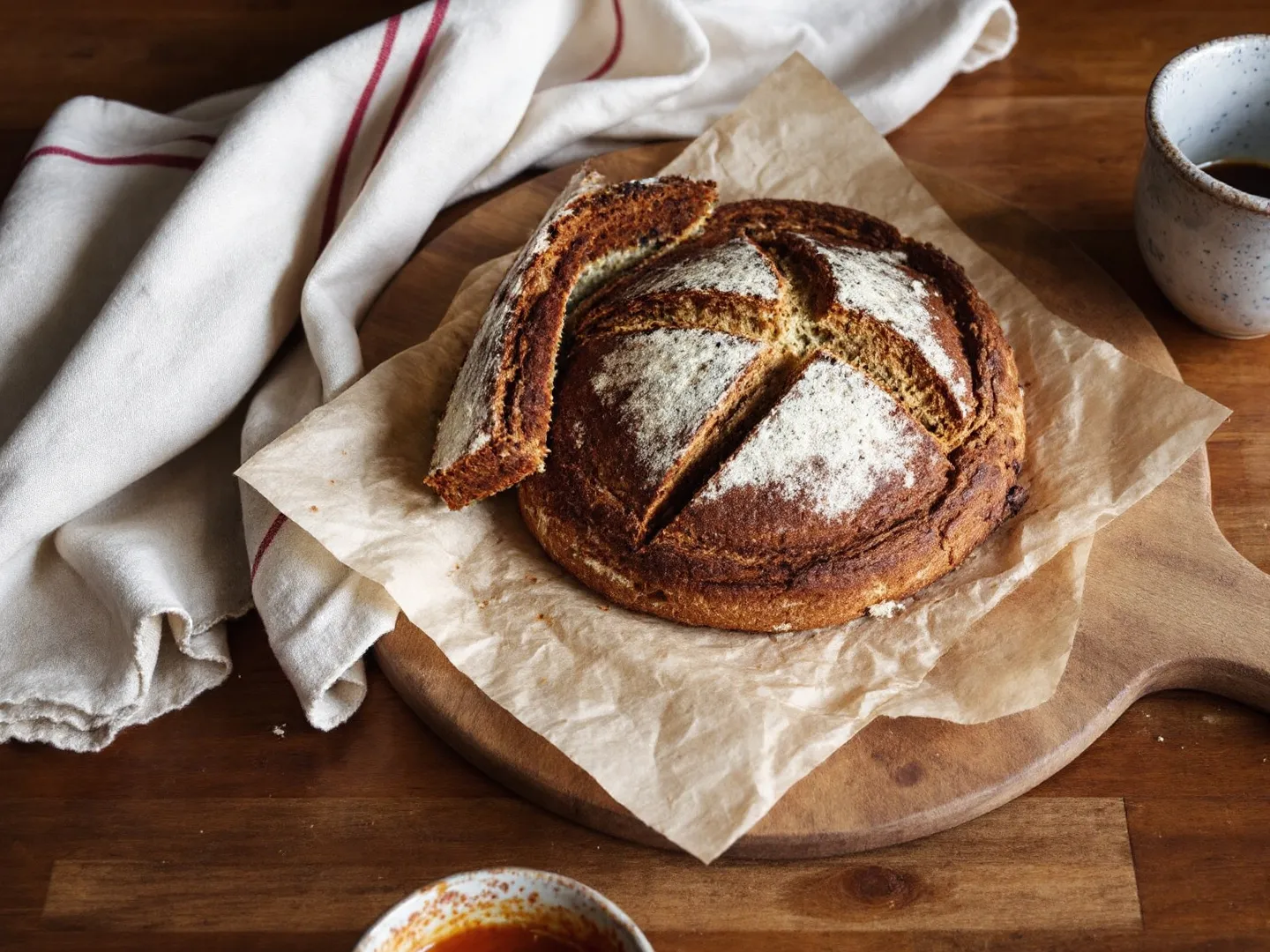
Caraway, a little molasses, and a dough stickier than you expect, so keep your hands off the extra flour. Bake it with a pan of steam, and listen to the crust crackle as it cools.
The short version
Stir warm water, molasses and yeast into half rye, half bread flour, knead until smooth, rise once, shape a round, rise again, then bake at 450°F with a pan of steam for about 40 minutes. Don't add extra flour, and don't let it over-rise.
What makes ours better
why ours wins the argument at dinner
-
Use dark rye and bread flour in equal parts. Dark rye gives real rye flavor; bread flour supplies the gluten rye lacks, so the loaf rises and slices cleanly instead of coming out like a brick.
-
Add molasses and caraway. A spoonful of molasses gives the color and slight sweetness of deli rye, and caraway gives the flavor people expect. Both are one-ingredient upgrades.
-
Cut the rises short. Rye ferments fast and its structure is fragile. Stop when the dough is puffy rather than doubled and the crumb stays tender instead of dense and sour.
-
Bake with steam. A pan of boiling water in the oven keeps the surface soft while the loaf springs, then dries into a thin, crisp crust.
What you need
the stars of the show
- Unsulphured molasses1 tablespoon
- Instant or active dry yeast1½ teaspoons
- Dark rye flour1¾ cups
- Bread flour2¼ cups
- Cornmeal1 tablespoon
yes, all of the butter
Steps
apron on. phone down. mostly.
-
Mix the dough
In a large bowl, stir the warm water, molasses, oil and yeast together. Add both flours, the caraway and the salt, and stir until no dry flour remains. The dough will be sticky and heavy, which is normal for rye.
Resist adding more flour. Rye dough is tacky even when it's right, and extra flour makes a dry loaf.
-
Knead until smooth
Knead with a dough hook on medium-low for 8 minutes, or by hand on a lightly floured counter for 10 minutes, using a bench scraper and wet hands to manage the stickiness. It's ready when the dough is smooth, elastic and springs back slowly when poked.
-
Rise once
Put the dough in an oiled bowl, turn it to coat, and cover. Let it rise somewhere warm for 60 to 75 minutes, until it looks puffy and about 1½ times its size.
Don't wait for double. Over-risen rye collapses in the oven and tastes sour.
About 60 min. Cook mode has a timer for this step.
-
Shape a round
Line a baking sheet with parchment and sprinkle it with cornmeal. Turn the dough onto a floured counter and fold the edges into the middle. Flip it seam-side down and cup your hands around it, turning it to tighten the surface into a smooth round. Set it on the sheet.
-
Rise again
Cover loosely with a clean towel or oiled plastic and let it rise for 45 to 60 minutes, until puffy. Meanwhile, set one rack in the center and one in the lower third of the oven, put an empty metal pan on the lower rack, and heat the oven to 450°F.
About 45 min. Cook mode has a timer for this step.
-
Slash and bake with steam
Dust the loaf lightly with flour and cut three shallow slashes across the top with a sharp knife. Slide the sheet onto the center rack, then carefully pour 1 cup of boiling water into the hot pan and shut the door fast. Bake 35 to 45 minutes, until deep brown and the bottom sounds hollow when tapped, or until a thermometer in the center reads 205°F.
About 40 min. Cook mode has a timer for this step.
-
Cool completely
Move the loaf to a rack and cool for at least 2 hours before slicing. The crumb is still setting, and a warm rye loaf slices gummy.
This is the hardest part. Cutting too early is the most common rye mistake.
Good to know
the stuff I’d tell you over the phone
- Dark rye flour has more flavor than light rye. If you only have light, the loaf will be milder and a little lighter in color.
- For a stronger tang, mix the water, yeast and 1 cup of the bread flour the night before and leave it covered at room temperature, then add the rest in the morning.
- To bake in a 9×5-inch loaf pan, shape the dough into a log, drop it into a greased pan for the second rise, and bake 40 to 45 minutes.
- Storage. Wrapped in a kitchen towel or paper bag at room temperature, 3 days. Sliced and frozen in a zip-top bag, 3 months; toast from frozen.
Questions, answered
asked and answered at the kitchen counter
Why is my rye bread dense?
Usually too little gluten or too long a rise. Keep the bread flour at about half, knead fully, and stop both rises when the dough is puffy rather than doubled.
Can I make rye bread without caraway?
Yes. Leave it out and the loaf tastes more like plain, slightly sweet rye. Fennel seeds are a milder substitute, or use poppy seeds on top.
Why is rye dough so sticky?
Rye flour holds a lot of water and has little gluten, so the dough stays tacky. Use wet hands and a bench scraper rather than extra flour.
How do I know when rye bread is done?
The crust is deep brown, the bottom sounds hollow when tapped, and the center reads 205°F on an instant-read thermometer.
Can I make this with sourdough starter?
Yes. Replace 100 g of the flour and 100 g of the water with 200 g of active starter and cut the yeast to a pinch. Expect longer rises and watch the dough, not the clock.
From the table
Made it? Tell me how it went, and who went back for seconds when they thought nobody was looking.
Made it?
stars first, story second. I read every one.
Tap a star
- No reviews yet. Yours would be the first, and I’d read it twice.
Find it in
Published October 29, 2026.