Breakfast / Pancakes, waffles & French toast
Dutch Baby with Lemon and Powdered Sugar
Not rated yet. Be the first.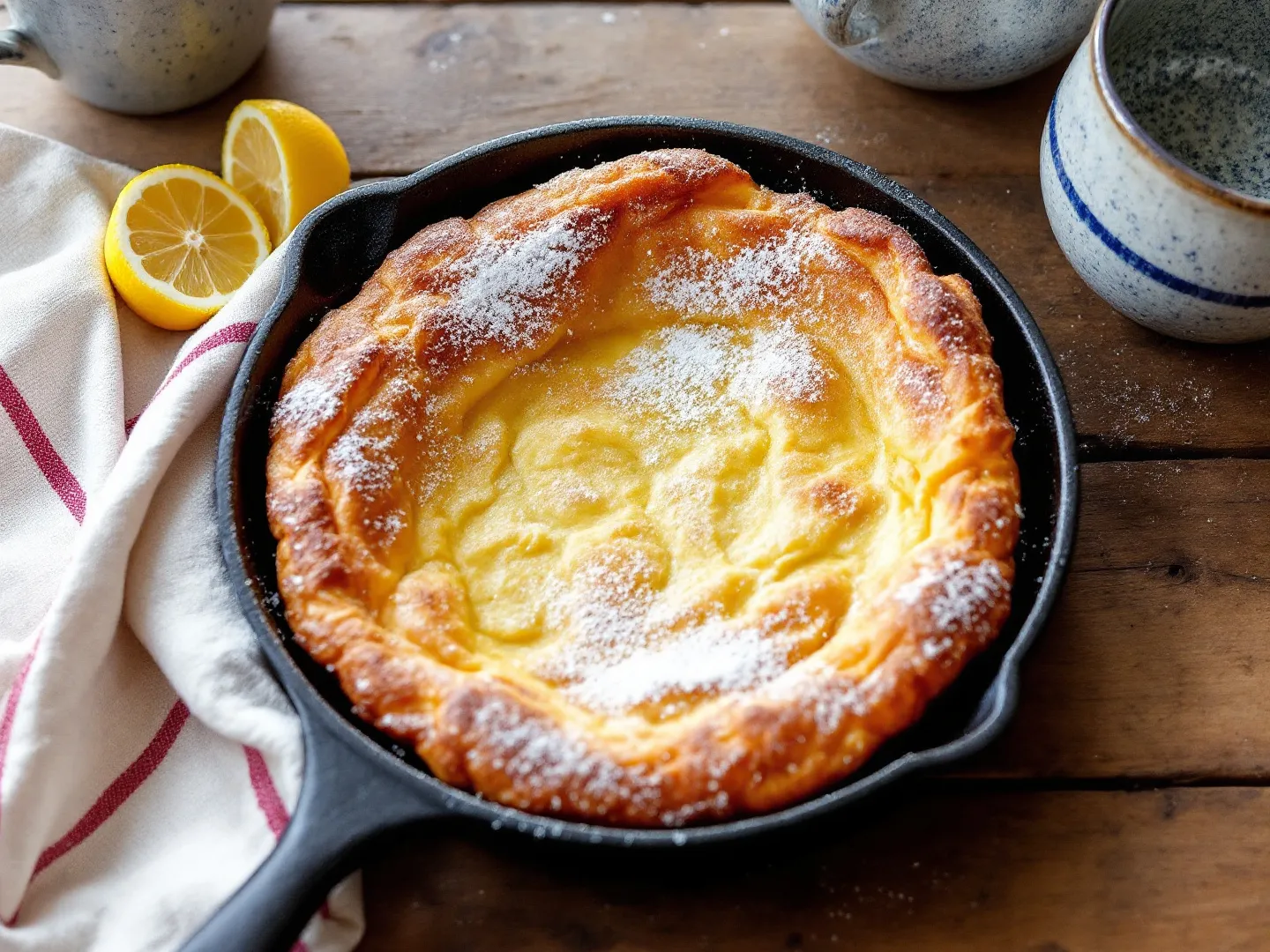
Watch it climb the sides of the skillet through the oven window, puffed and golden. Keep the door shut, then rush it to the table with lemon and powdered sugar before it sighs back down.
The short version
Blend eggs, milk, flour, salt and a little sugar. Pour into a skillet of sizzling butter and bake at 425°F for 15 minutes, then 350°F for 10 to 15 more. Don't open the door early, and serve the second it's out.
What makes ours better
why ours wins the argument at dinner
-
Heat the skillet in the oven first. Batter that hits a hot, buttery pan starts rising and crisping the instant it lands. That's where the tall, ruffled edges come from.
-
Blend the batter and let it warm up. A blender makes the batter smooth and a little frothy in 20 seconds. Room-temperature eggs and milk rise higher than cold ones.
-
Add vanilla, a spoon of sugar and a squeeze of lemon. Plain batter tastes like a popover. A little sugar and vanilla in the batter and lemon at the end make it taste like breakfast.
What you need
the stars of the show
- Eggs2 large
- Whole milk½ cup
- All-purpose flour½ cup
- Granulated sugar1 tablespoon
- Vanilla extract½ teaspoon
- Unsalted butter4 tablespoons
- Lemon1 large
yes, all of the butter
Steps
go slow. the good part can’t be rushed.
-
Warm the eggs and milk
Set the eggs and milk on the counter while you gather everything else. If you forgot, put the eggs in a bowl of warm tap water for 5 minutes and microwave the milk for 15 seconds.
-
Heat the oven and skillet
Set a rack in the lower third of the oven. Put a 10-inch cast-iron or other ovenproof skillet on it and heat the oven to 425°F. Let the skillet heat for the full preheat, about 15 minutes.
-
Blend the batter
Blend the eggs, milk, flour, granulated sugar, vanilla and salt for 20 seconds, until smooth and a little foamy. No blender? Whisk hard for a full minute. Let it sit while the skillet finishes heating.
About 5 min. Cook mode has a timer for this step.
-
Melt the butter in the hot pan
Using oven mitts, pull out the rack and drop the butter into the skillet. It will sizzle. Swirl until it melts and coats the bottom and a little way up the sides, about 30 seconds. Don't let it brown past gold.
The handle is as hot as the pan. Drape a towel over it so you don't grab it later.
-
Pour and bake
Pour the batter into the center of the sizzling butter and slide the rack back in. Bake for 15 minutes without opening the door. The edges will climb the sides and turn deep gold.
About 15 min. Cook mode has a timer for this step.
-
Finish at a lower heat
Lower the oven to 350°F and bake 10 to 15 minutes more, until the sides are tall and dark golden and the center is set and no longer wet.
About 12 min. Cook mode has a timer for this step.
-
Dust and serve right away
Carry the skillet to the table, dust with powdered sugar and squeeze lemon over the top. Cut into wedges. It starts to settle in a couple of minutes, which is normal.
Good to know
the stuff I’d tell you over the phone
- Fill the middle with fruit, jam or a spoon of yogurt, or skip the sugar and vanilla and top it with a fried egg, sautéed greens and a little cheese.
- Keep the ratio of 1 egg to ¼ cup each of milk and flour if you need a different size. Use a pan that fits, a 12-inch skillet wants 3 eggs, ¾ cup milk and ¾ cup flour.
- A 9×13-inch dish or two 9-inch cake pans work if you don't have a skillet. Heat the buttered pan the same way and go by the color.
- Storage. Best eaten straight from the oven. Leftover wedges keep covered in the fridge for 2 days; reheat in a 350°F oven for 5 to 8 minutes.
Questions, answered
asked and answered at the kitchen counter
Why did my Dutch baby not puff?
Usually the oven or pan wasn't hot enough, or the eggs and milk were cold. Heat the skillet for the whole preheat, use room-temperature eggs and milk, and keep the door shut for the first 15 minutes.
Why did it deflate so fast?
Every Dutch baby falls once it leaves the oven, because the steam that puffed it escapes. A well-baked one keeps some height for a few minutes, so serve it right away. If it collapses in the oven, it needs a few more minutes.
Can I make it without a cast-iron skillet?
Yes. Any ovenproof skillet, a 9-inch cake pan or a 9×13-inch baking dish works. Cast iron holds heat best and gives the tallest edges.
Can I make the batter ahead?
You can blend it up to a day ahead and keep it in the fridge. Let it come to room temperature for 30 minutes and whisk before pouring, since cold batter rises less.
Can I double it?
Make two in two skillets rather than one thick one. A deep batter doesn't set in the middle before the edges burn.
From the table
Made it? Tell me how it went, and who went back for seconds when they thought nobody was looking.
Made it?
stars first, story second. I read every one.
Tap a star
- No reviews yet. Yours would be the first, and I’d read it twice.
Learn the technique
Find it in
Published October 28, 2026.