Dry-Brined Roast Turkey
Not rated yet. Be the first.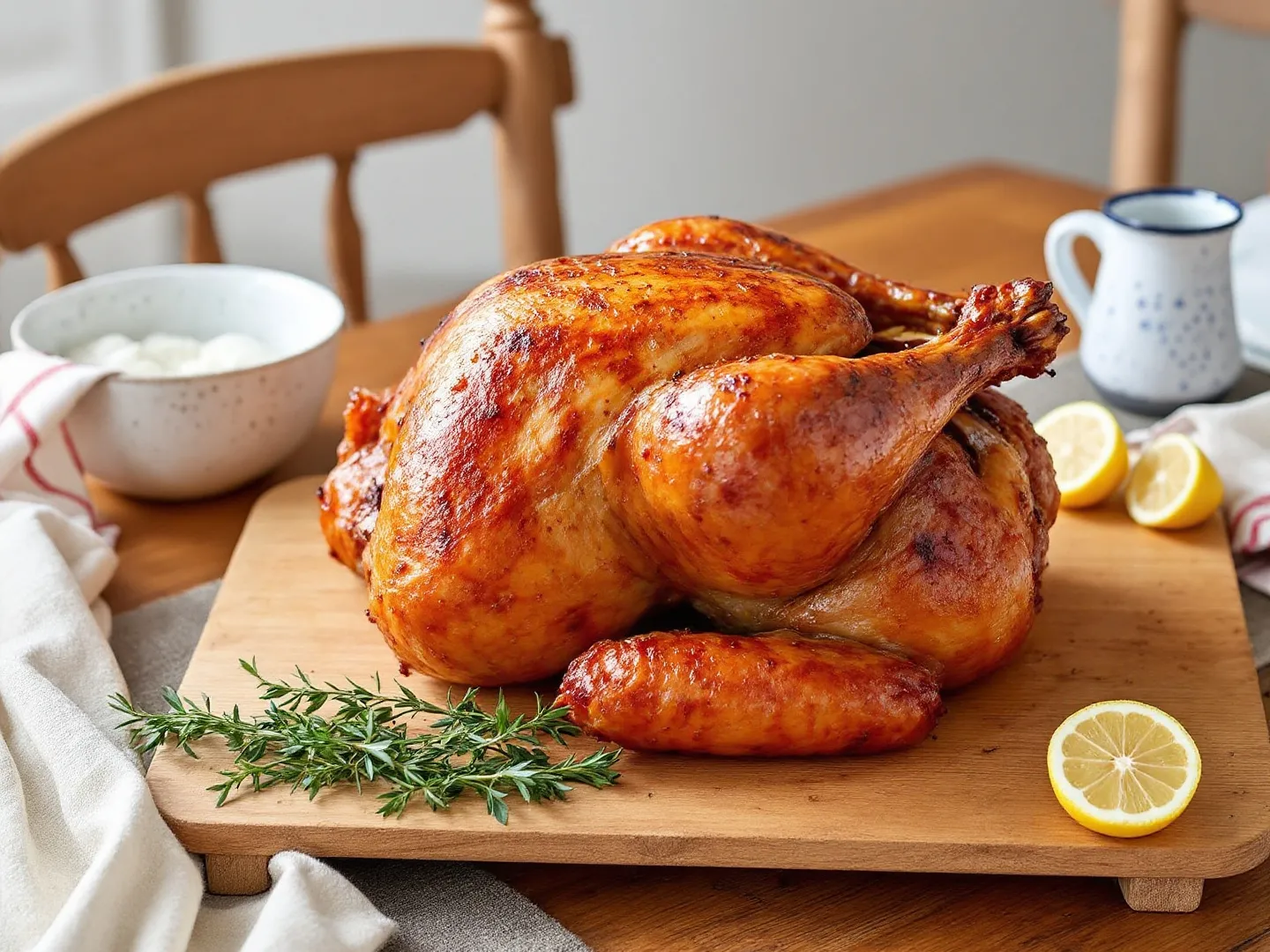
Salt, time and a thermometer are the whole plan. Rub the salt on a day or two ahead, roast hot, then low. The skin comes out bronze and crackling, and the thirty-minute rest is when the whole family suddenly finds a reason to be in the kitchen.
The short version
Rub a 12- to 14-pound turkey with kosher salt and a spoonful of baking powder and refrigerate it uncovered for 1 to 2 days. Roast at 425°F for 30 minutes, then at 325°F until the thigh reads 170°F to 175°F, about 2¾ to 3½ hours in all, and rest it 30 minutes before carving. The thermometer is the one thing you can't skip.
What makes ours better
what we fixed so you don’t have to
-
Dry-brine it, uncovered, a day or two ahead. Salt rubbed on 24 to 48 hours ahead works its way through the meat, so every slice is seasoned and holds its juice. Sitting uncovered in the fridge dries the skin, which is what lets it brown and crackle. No bucket of brine, no cooler on the porch.
-
Put a little baking powder in the salt. Baking powder nudges the skin's surface toward alkaline, which speeds browning and gives a thinner, crisper skin; a tablespoon is enough for a 12- to 14-pound bird. Baking soda does the same job but can taste metallic, so stick with powder.
-
Start at 425°F, finish at 325°F. Half an hour of high heat gets the color going on skin that's already dry; dropping to 325°F cooks the bird through without drying out the breast. No basting, either. Opening the door drops the oven temperature, and wet skin won't crisp.
-
Cook to temperature, pull early, rest 30 minutes. The breast is done at 160°F and dry past 170°F, while the thighs want 170°F or higher. Pull the bird when the thigh reads 170°F to 175°F and the breast 155°F to 160°F; it climbs another 5 to 10 degrees while it rests. If the thighs lag, carve them off and send them back without the breast.
What you need
the usual suspects
- Whole turkey1
- Yellow onion1 medium
- Lemon1
- Fresh thyme and sage1 small bunch
- Unsalted butter4 tablespoons
tap each one as it goes in. no double-salting.
Steps
deep breath. you’ve got this.
-
Salt the turkey, 1 to 2 days ahead
Pat the turkey dry inside and out. Stir the salt, baking powder and pepper together, then sprinkle it over the whole bird, heaviest on the breast and thighs, with a pinch inside the cavity. Set it breast up on a rack over a rimmed sheet pan and refrigerate it uncovered for 24 to 48 hours. By roasting day the salt has disappeared and the skin looks dry, tight and a little translucent.
Don't rinse it. The salt is in the meat now, and water on the skin undoes the drying you just waited for.
-
Take it out, heat the oven
An hour before roasting, take the turkey out of the fridge. Tuck the wing tips behind the back, fill the cavity with the onion, lemon and herbs, and tie the drumsticks together with kitchen twine. Set the bird breast up on a V-rack in a roasting pan (a rack on a rimmed sheet pan also works) and pour the water into the pan so the first drippings don't scorch. Set an oven rack in the lower third and heat the oven to 425°F.
-
Brush with butter
Brush the melted butter over the breast, legs and wings. Don't add salt; the brine took care of that.
-
Roast hot for 30 minutes
Roast at 425°F for 30 minutes. The skin should be starting to turn gold and the pan should be sizzling.
About 30 min. Cook mode has a timer for this step.
-
Turn it down and leave it alone
Lower the oven to 325°F and keep roasting. Don't baste, and don't open the door more than you have to. If the breast is already deep brown while the thighs are still well under temperature, lay a sheet of foil loosely over the breast. Start checking the temperature after 2 hours total.
If the pan runs dry and starts to smoke, add another cup of water.
About 90 min. Cook mode has a timer for this step.
-
Check the temperature
Slide a thermometer into the thickest part of the thigh without touching bone, then into the deepest part of the breast. You're looking for 170°F to 175°F in the thigh and 155°F to 160°F in the breast, usually 2¾ to 3½ hours from the start. If the breast is there and the thighs are more than 10 degrees behind, take the bird out, cut the legs off at the hip joint and return them to the oven on a sheet pan while the rest of the bird rests.
The plastic pop-up that comes in some birds is not a thermometer you should trust. Use your own.
-
Rest 30 minutes
Move the turkey to a carving board or platter, tent it loosely with foil and leave it for 30 minutes (45 is fine). The breast will climb to at least 165°F as it sits, and the juices settle back into the meat instead of running onto the board. Pour the pan juices into a measuring cup for the gravy.
About 30 min. Cook mode has a timer for this step.
-
Carve
Cut through the skin between breast and thigh, bend each leg back until the joint pops, and cut it free. Separate drumsticks from thighs at the joint. Run the knife down one side of the breastbone and follow the rib cage to lift off each breast half in one piece, then slice it crosswise against the grain. Cut off the wings last. Arrange everything on a warm platter and spoon a little of the pan juice over the breast.
Good to know
the stuff I’d tell you over the phone
- Thawing takes longer than you think. In the fridge, allow about a day for every 4 to 5 pounds, so a frozen 12- to 14-pound bird needs 3 days before you can even salt it. Buy it 5 days ahead.
- Short on time? Even one night of dry brining, uncovered, is better than none. With less than that, skip the rub, pat the skin dry and salt the bird the usual way just before roasting.
- Kosher, self-basting and pre-brined turkeys are already salted. Skip the salt rub, but still leave the bird uncovered in the fridge overnight so the skin dries.
- Bigger bird? The method holds for 15 to 18 pounds; expect 3½ to 4¼ hours and go by the thermometer. Add a tablespoon more salt for every 4 pounds.
- Storage. Carved and refrigerated in a covered container, 3 to 4 days. Freeze slices with a spoonful of stock or gravy in a zip-top bag for up to 3 months. Reheat covered with a splash of stock at 325°F until just hot, or eat it cold in a sandwich.
Questions, answered
the questions my cousins text me
How long does it take to roast a 12- to 14-pound turkey?
With this method, 2¾ to 3½ hours. At a steady 325°F with no hot start, the standard guidance is 3 to 3¾ hours for an unstuffed bird. Either way the clock is an estimate; the thermometer decides.
What temperature should turkey be cooked to?
165°F everywhere is the safe minimum. For the best texture, pull the bird when the thigh reads 170°F to 175°F and the breast 155°F to 160°F; the breast rises past 165°F during the 30-minute rest while the thighs finish where dark meat tastes right.
Can I stuff this turkey?
You can, but we'd rather you didn't. Stuffing has to reach 165°F in the center, and by the time it does the breast is overcooked. Bake it in a dish while the bird rests and it gets a crisp top too.
Do I need to baste?
No. Basting doesn't moisten the meat, it wets the skin you worked to dry, and every time the door opens the oven loses heat. The butter at the start is all the skin needs.
Can I dry-brine a self-basting or kosher turkey?
Skip the salt; those birds are already brined and will be too salty with more. Still give the skin a night uncovered in the fridge to dry out, then roast as written.
Why was my turkey breast dry?
It cooked too long. Check the breast as well as the thigh, pull at 155°F to 160°F in the breast, and if the thighs aren't there yet, take the legs off and finish them separately. A dry brine buys you some margin, but no brine survives 180°F.
From the table
Made it? I want the full report: first bite, best compliment, and who tried to take the leftovers home.
Made it?
one star means we talk. five means I tell Dad.
Tap a star
- No reviews yet. Yours would be the first, and I’d read it twice.
Find it in
Published October 26, 2026.