Sides / Potatoes & sweet potatoes
Creamy Garlic Scalloped Potatoes
Not rated yet. Be the first.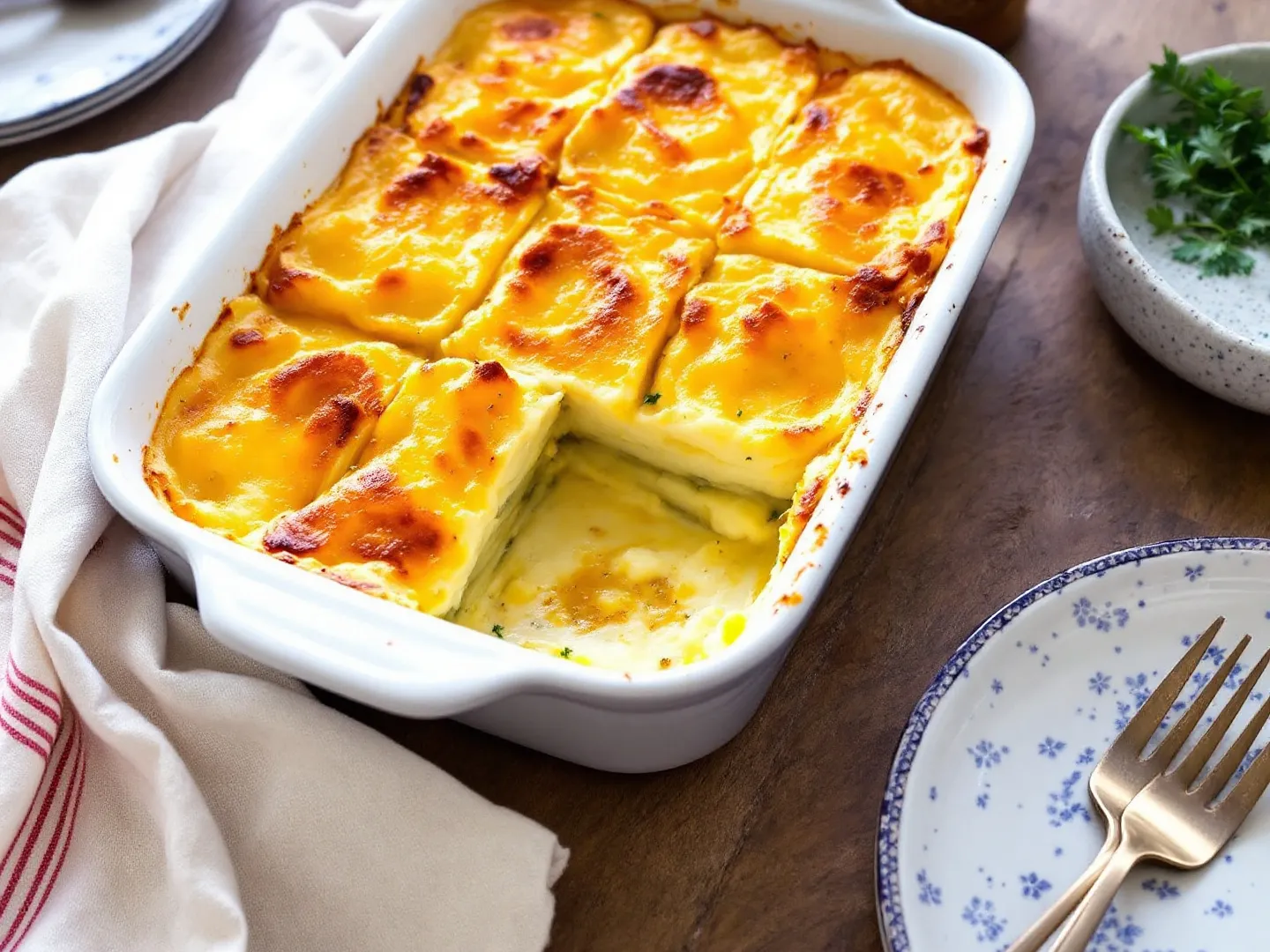
Potato slices simmer first in cream with garlic and thyme, then bake until the top is browned and the edges bubble. Give it a fifteen-minute rest, and the whole table circles the dish with a spoon.
The short version
Slice 3 pounds of russets ⅛ inch thick, simmer them covered in cream, milk, garlic and thyme for about 10 minutes, then pour into a buttered dish and bake at 400°F for 30 to 40 minutes until browned and bubbling. Let it rest 15 minutes. Don't rinse the slices; their starch thickens the sauce.
What makes ours better
why ours wins the argument at dinner
-
Simmer the potatoes in the cream first. Ten minutes on the stove starts the slices cooking evenly from top to bottom, so you never get crunchy layers in the middle, and it cuts the oven time from well over an hour to about 30 minutes.
-
Don't rinse the slices. The starch on the cut potatoes thickens the cream as it simmers, which gives you a smooth, silky sauce without a flour roux and keeps it from separating in the oven.
-
Cream with some milk, steeped with garlic and thyme. All milk tends to curdle; all cream is heavy. Mostly cream with a cup of milk stays smooth and still tastes light enough for a second helping, and the garlic and thyme cook right into it.
What you need
the stars of the show
- Russet potatoes3 pounds
- Unsalted butter2 tablespoons
- Garlic3 cloves
- Fresh thyme leaves1 tablespoon
- Heavy cream2 cups
- Whole milk1 cup
- Ground nutmeg1 pinch
- Bay leaves2 large
tap each one as it goes in. no double-salting.
Steps
go slow. the good part can’t be rushed.
-
Heat the oven, butter the dish
Heat the oven to 400°F with a rack in the middle. Butter a 13×9-inch or other shallow 3-quart baking dish.
-
Slice the potatoes
Peel the potatoes and slice them ⅛ inch thick, using a mandoline, the slicing disk of a food processor, or a sharp knife. Keep the slices in a pile on the board; don't put them in water.
Uneven slices are the main reason scalloped potatoes have hard spots. Aim for the thickness of a coin.
-
Build the cream
Melt the butter in a large Dutch oven or wide pot over medium heat. Add the garlic and thyme and cook, stirring, until fragrant but not browned, about 30 seconds. Pour in the cream and milk and add the salt, pepper, nutmeg and bay leaves.
-
Simmer the potatoes
Add the potato slices and bring to a simmer, gently folding with a spatula to separate the slices and keep them from sticking to the bottom. Cover, turn the heat to medium-low and simmer, folding gently every few minutes, until the edges of the slices are tender but the centers still resist a knife, about 10 minutes. The cream will have thickened noticeably.
Scrape the bottom as you fold. The starch makes the cream want to catch.
About 10 min. Cook mode has a timer for this step.
-
Fill the dish
Fish out the bay leaves. Pour the potatoes and every bit of cream into the buttered dish and press them flat with the spatula so the slices lie in even layers and the cream comes up nearly to the top.
-
Bake
Bake until the top is golden brown in spots, the cream is bubbling thickly around the edges, and a knife slides through the center layers with no resistance, 30 to 40 minutes.
About 30 min. Cook mode has a timer for this step.
-
Rest 15 minutes
Let it stand at least 15 minutes. The sauce settles and thickens as it cools slightly, so it cuts into tidy squares instead of sliding across the plate.
About 15 min. Cook mode has a timer for this step.
Good to know
things I learned the hard way, so you can skip that part
- Russets give the most cohesive layers and thickest sauce. Yukon Golds hold their shape a little better and taste more buttery; either works with the same timing.
- To make ahead, fill the dish, cool, cover with foil and refrigerate up to 1 day. Bake covered at 375°F for 30 minutes, then uncover and bake 25 to 30 minutes more, until browned and bubbling.
- For a richer, cheesy top that keeps it scalloped, scatter ½ cup of grated Parmesan or Gruyère over the potatoes before baking.
- Storage. Refrigerated, covered, 4 days. Reheat covered at 350°F for 20 to 25 minutes, or individual portions in the microwave. Freezing makes the potatoes grainy.
Questions, answered
asked and answered at the kitchen counter
What's the difference between scalloped potatoes and au gratin?
Scalloped potatoes are sliced potatoes baked in a cream or milk sauce, with little or no cheese. Au gratin potatoes have cheese layered all through, often with crumbs on top. Ours is the scalloped kind; to make it au gratin, fold 1½ cups of grated Gruyère into the potatoes before they go into the dish and sprinkle another ½ cup on top.
Why did my scalloped potatoes curdle?
Too much milk and too little fat, usually, or a sauce baked at a hard boil for a long time. Mostly cream with a little milk, and the potato starch from unrinsed slices, keeps it smooth.
Why are my scalloped potatoes still hard in the middle?
The slices were too thick or uneven, or they went into the oven raw. Slice them ⅛ inch thick and give them the 10-minute simmer on the stove so every layer starts cooking at once.
Do I need flour for scalloped potatoes?
No. The starch from the cut potatoes thickens the cream as it simmers. Flour is a way to stretch a milk-only sauce, and you don't need it here.
Can I make scalloped potatoes ahead?
Yes. Assemble the dish up to a day ahead and refrigerate it, then bake covered at 375°F for 30 minutes and uncovered for 25 to 30 more.
From the table
Made it? I want the full report: first bite, best compliment, and who tried to take the leftovers home.
Made it?
stars first, story second. I read every one.
Tap a star
- No reviews yet. Yours would be the first, and I’d read it twice.
Find it in
Published October 26, 2026.