Baking / Loaves & yeast breads
No-Knead Dutch Oven Bread
Not rated yet. Be the first.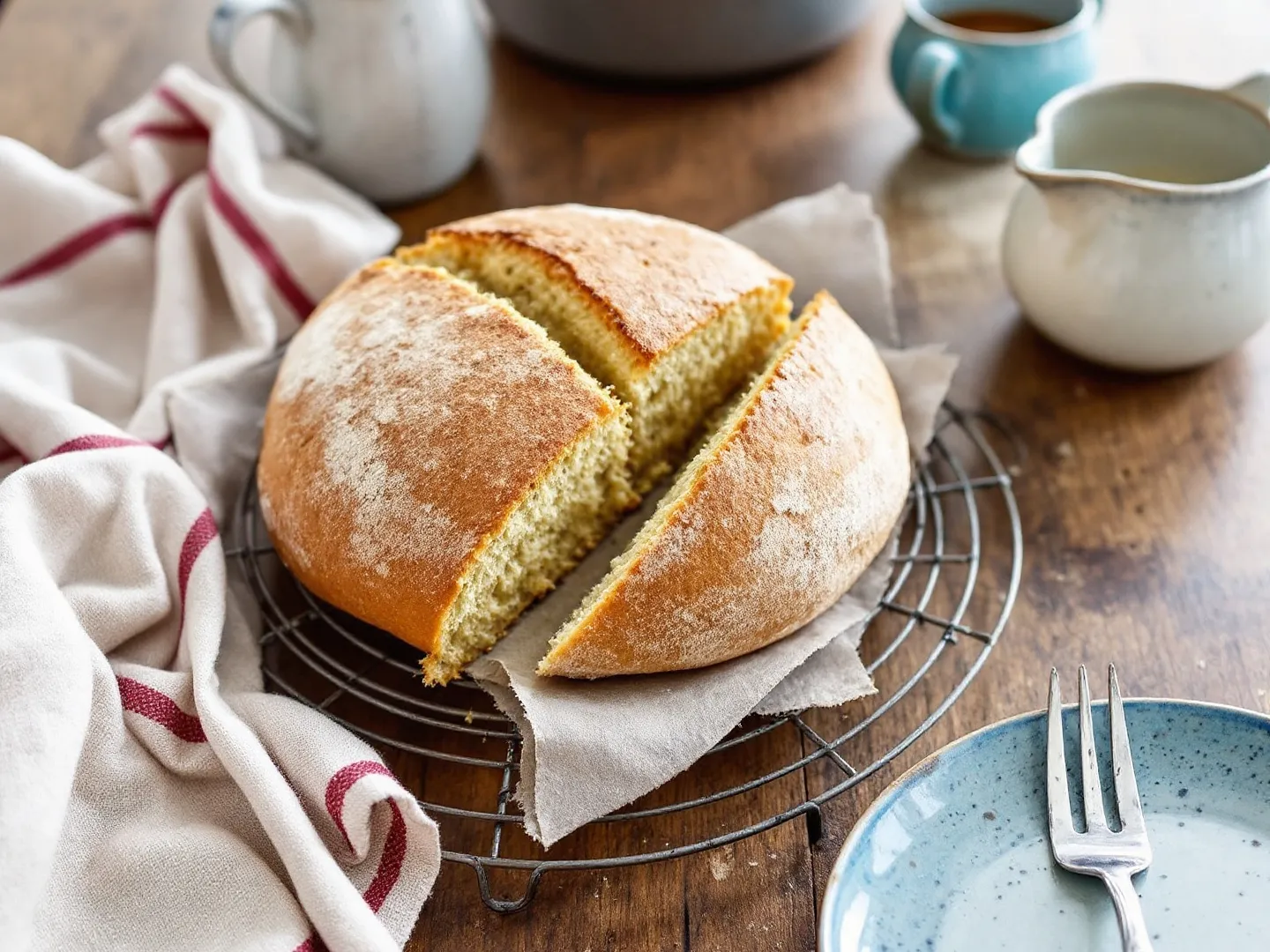
A shaggy bowl of dough, twelve to eighteen hours of quiet, and a loaf with a crust that crackles as it cools. The hardest part is waiting to slice it, and the whole house will be standing there while you do.
The short version
Stir four ingredients into a shaggy dough, rest 12 to 18 hours, fold it into a ball, and rest 30 minutes. Bake in a screaming-hot Dutch oven at 475°F, 30 minutes covered and 15 to 20 more uncovered. Don't slice until it cools.
What makes ours better
the tricks Nonna pretends she never taught me
-
Let it rise 12 to 18 hours. Time replaces kneading. Long, slow fermentation builds gluten on its own and develops the toasty, slightly tangy flavor of bakery bread.
-
Bake it on a parchment sling. Dropping dough into a 475°F pot is how people burn their forearms. A sheet of parchment lets you lower the loaf in safely, and the loaf lifts out just as easily.
-
Bake to 205°F inside. Crust color lies. An instant-read thermometer tells you the center is set, so the crumb is not gummy.
tap each one as it goes in. no double-salting.
Steps
nobody opens the oven door. looking at you, Dad.
-
Stir the dough
In a large bowl, whisk the flour, salt and yeast. Pour in the water and stir with a spatula or wooden spoon until no dry flour remains. The dough will be shaggy, sticky and wet. That is right.
-
Let it rise overnight
Cover the bowl with plastic wrap or a plate and leave it at room temperature, about 70°F, for 12 to 18 hours. It's ready when it has more than doubled, the surface is dotted with bubbles and it smells yeasty and a little sour.
In a warm kitchen, check at 12 hours. In a cool one, give it the full 18.
About 720 min. Cook mode has a timer for this step.
-
Fold and shape
Scrape the dough onto a well-floured counter. With floured hands, fold the edges in toward the center, turning the dough as you go, 4 or 5 times. Flip it seam side down and tuck it into a ball with cupped hands.
-
Rest on parchment
Set the ball, seam side down, on a sheet of parchment and sprinkle the top with flour. Cover it loosely with a towel and let it rest for 30 minutes while the oven heats.
About 30 min. Cook mode has a timer for this step.
-
Heat the Dutch oven
Put a 5- to 6-quart Dutch oven with its lid in the oven and heat it to 475°F for at least 30 minutes, until the oven and the pot are both fully hot.
Use a pot with a metal knob. A plastic lid knob melts at this temperature.
-
Score and load
Slash the top of the loaf once with a sharp knife or razor, about ½ inch deep. Wearing oven mitts, lift the lid off the pot, lift the dough by the parchment corners and lower it into the pot. Cover.
-
Bake covered, then uncovered
Bake covered for 30 minutes. Take off the lid and bake until the crust is deep brown and the center reads 205°F to 210°F on an instant-read thermometer, 15 to 20 minutes more. If the top browns too fast, lower the oven to 450°F.
About 30 min. Cook mode has a timer for this step.
-
Cool completely
Lift the loaf out by the parchment onto a rack. You'll hear it crackle as it cools. Wait at least an hour before slicing.
Slicing early squashes the crumb and makes it gummy, because the inside is still steaming and setting.
Good to know
read this before somebody asks for seconds
- Bread flour gives the chewiest crumb and the tallest loaf. All-purpose works well too, though the dough will be a little looser.
- No Dutch oven? Use any heavy, oven-safe pot with a lid. A covered roasting pan works. Without a lid, bake on a preheated sheet pan with a pan of hot water on the rack below.
- For a whole-grain version, swap 60 g (½ cup) of the flour for whole wheat. For add-ins like olives, rosemary or cheese, fold them in at step 3.
- Storage. Cut side down on a board, uncovered, for the first day, then in a paper bag for up to 3 days. Sliced and frozen in a zip-top bag, 3 months. Refresh in a 350°F oven for 10 minutes.
Questions, answered
the questions my cousins text me
Why is my no-knead bread dense?
The usual causes are a short rise, a cold kitchen or an old pot of yeast. Let the dough double and show bubbles before you shape it, and check that your yeast is fresh.
Can I make no-knead bread without a Dutch oven?
Yes. Use any heavy pot with a lid, or bake on a preheated baking sheet with a pan of boiling water on the bottom rack for steam. The Dutch oven gives the crispest crust.
Can I let the dough rise in the fridge?
Yes. A cold rise of 24 to 48 hours is slower but tastier. Pull the dough out, shape it and let it warm for about an hour before baking.
How do I know when no-knead bread is done?
The crust is deep brown and the loaf sounds hollow when you tap the bottom. The surest sign is an internal temperature of 205 to 210°F.
Can I use less salt or skip the yeast?
Don't cut the salt, since it controls the yeast and flavors the bread. Don't skip the yeast either, because only a small pinch of it is doing all the work.
From the table
Made it? Tell me how it went, and who went back for seconds when they thought nobody was looking.
Made it?
be honest. I can take it. probably.
Tap a star
- No reviews yet. Yours would be the first, and I’d read it twice.
Find it in
Published October 29, 2026.