All-Butter Pie Crust
Not rated yet. Be the first.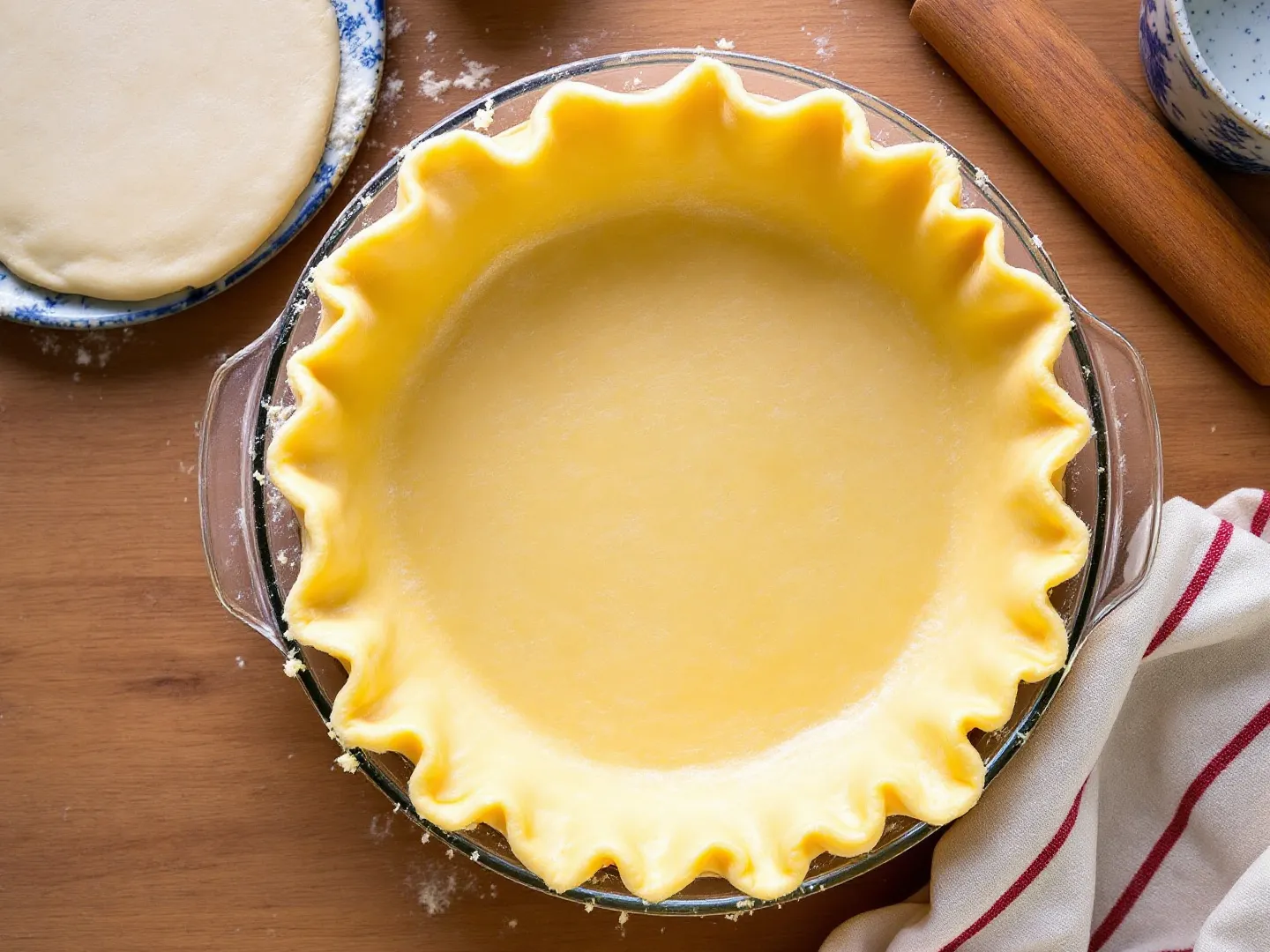
Cold butter pressed flat into the flour, a spoon of vinegar in the ice water, and one fold. Your hands do all the work, and the crust bakes into thin, flaky layers. It makes two, because one pie is never enough.
The short version
Flatten cold butter cubes into 2½ cups of flour, toss in ice water with a spoon of vinegar until it holds when squeezed, fold once, divide, chill an hour. Roll, line the pan, and for custard or no-bake pies, blind-bake at 375°F with weights. Keep everything cold.
What makes ours better
what we fixed so you don’t have to
-
All butter, in big flat pieces. Butter tastes like butter; shortening tastes like nothing. Flattening the cubes between your fingers instead of crumbling them leaves sheets of fat that steam apart into visible flaky layers.
-
Freeze the butter for 10 minutes first. Cold butter stays in pieces while you work. Ten minutes in the freezer buys you time to flatten it before it smears into the flour, which matters most in a warm kitchen.
-
A spoon of vinegar in the water. A tablespoon of cider vinegar relaxes the gluten so the dough rolls out without springing back or shrinking in the oven. You won't taste it.
-
Fold it once before chilling. Pat the shaggy dough into a rectangle and fold it like a letter. One fold stacks the butter sheets and turns a crumbly dough into one that rolls clean, with more layers for no extra chilling time.
What you need
the usual suspects
- All-purpose flour2½ cups
- Granulated sugar1 tablespoon
- Unsalted butter1 cup
- Apple cider vinegar1 tablespoon
tap each one as it goes in. no double-salting.
Steps
nobody opens the oven door. looking at you, Dad.
-
Chill everything
Spread the butter cubes on a plate and put them in the freezer for 10 minutes. Fill a measuring cup with water and a handful of ice and set it aside. Whisk the flour, sugar and salt together in a large, wide bowl.
About 10 min. Cook mode has a timer for this step.
-
Flatten the butter in
Toss the cold cubes in the flour to coat them. Then work through the bowl pressing each piece flat between your thumb and fingers, turning the bowl as you go, until all the butter is in flat, flour-dusted flakes, most between a pea and a quarter in size. It takes 2 to 3 minutes. If the butter starts to feel soft or shiny, put the whole bowl in the fridge for 10 minutes and come back.
Stop before it looks like wet sand. Visible butter is the point; those flakes become the layers.
-
Add the water
Measure 6 tablespoons of the ice water (no ice) and stir in the vinegar. Drizzle it over the flour while tossing with a fork or rubber spatula. Squeeze a handful. If it holds together with a few crumbs falling off, stop. If it falls apart, add more water a teaspoon at a time, up to 2 more tablespoons. The dough should look shaggy and a little dry, never wet or sticky.
A slightly dry dough cracks when you roll it; a slightly wet one gets a bit tougher but rolls fine. On a first try, lean a touch wet.
-
Fold, divide and chill
Tip the dough onto a lightly floured counter and press it into a rough 6×9-inch rectangle, pushing any loose bits into the sides. Fold it in thirds like a letter and press it down. Cut it in half, shape each half into a 1-inch-thick disk, wrap in plastic and refrigerate at least 1 hour, or up to 3 days.
About 60 min. Cook mode has a timer for this step.
-
Roll it out
If the dough is rock hard, let it sit 5 to 10 minutes first. Lightly flour the counter, the dough and the pin. Roll from the center outward, giving the dough a quarter turn after every pass or two, until you have a 12-inch round about ⅛ inch thick. Pinch cracks closed as they appear and patch holes with a scrap and a dab of water. Slide a bench scraper underneath now and then to make sure it isn't sticking.
If the butter looks glossy or the dough feels sticky, slide it onto a sheet pan and chill it for 10 minutes instead of fighting it.
-
Line the pan
Roll the dough loosely around the pin and unroll it over a 9-inch pie plate. Lift the edges and let the dough settle into the corners on its own, then press it gently against the plate; stretching it now means shrinking later. For a single-crust pie, trim the overhang to 1 inch, fold it under itself so it sits on the rim, and crimp with your fingers or a fork. Freeze 15 minutes or refrigerate 30 before baking. For a double-crust pie, leave the overhang untrimmed and follow the pie recipe.
About 15 min. Cook mode has a timer for this step.
-
Weight and blind-bake
For custard pies and no-bake fillings. Heat the oven to 375°F. Prick the chilled bottom all over with a fork. Line the shell with parchment and fill it to the rim with pie weights, dried beans or granulated sugar. Bake until the edge is dry to the touch and light gold, about 25 minutes.
Don't skimp on the weights. A half-filled shell slumps down the sides as it bakes.
About 25 min. Cook mode has a timer for this step.
-
Finish the bake
Lift out the parchment and weights. Bake until the bottom is pale gold and dry, 8 to 10 minutes more; that's a par-baked shell, ready for pumpkin pie or any filling that will bake again. For a filling that won't be baked, keep going until the whole crust is golden brown, 5 to 10 minutes beyond that. Cool on a rack unless the pie recipe says to fill it warm.
If the bottom puffs up once the weights are out, press it down gently with the back of a spoon.
About 8 min. Cook mode has a timer for this step.
Good to know
read this before somebody asks for seconds
- Food processor version. Pulse the flour, sugar and salt, scatter the frozen butter over the top and pulse 6 to 8 times, until the largest pieces are the size of a hazelnut. Tip it into a bowl and add the water by hand so you don't overprocess.
- For a double-crust fruit pie, don't prick the bottom crust. Sprinkle it with a tablespoon each of flour and sugar mixed together before you add the fruit; it soaks up the first juices.
- A single crust is half of everything, so 1¼ cups flour, ½ cup butter, 3 tablespoons water plus ½ tablespoon vinegar, ½ teaspoon kosher salt. Or make the full batch and freeze the second disk for next time.
- Freeze the dough as disks for up to 3 months and thaw overnight in the fridge. You can also freeze a shaped shell in its pan, wrapped well, and blind-bake it straight from frozen; add a few minutes.
- Storage. Dough disks keep 3 days in the fridge and 3 months in the freezer. A blind-baked shell keeps a day at room temperature, loosely covered.
Questions, answered
the questions my cousins text me
Why does my pie crust shrink?
Three causes, in order. The dough was stretched to fit the pan instead of being eased in. It went into the oven without chilling, so the gluten was still tense. Or there weren't enough weights, so the sides slid down. Fill the weights to the rim and chill the lined pan before baking.
Can I make pie crust in a food processor?
Yes. Pulse the dry ingredients with the frozen butter until the biggest pieces are hazelnut-sized, then move it to a bowl and add the water by hand. The processor overdoes the water step in seconds.
Why is my pie crust tough instead of flaky?
Too much water or too much handling, which both build gluten. Add water only until a squeezed handful holds together, roll with as few passes as you can, and give the dough its hour in the fridge so the gluten relaxes.
Do I have to blind-bake the crust?
For a custard pie like pumpkin or a filling that won't be baked, yes; the crust needs a head start or the bottom stays raw. For a double-crust fruit pie like apple, no; the long bake does it.
Can I use salted butter?
Yes. Cut the kosher salt to ½ teaspoon. Everything else stays the same.
Can I make pie crust ahead?
Yes. The disks keep 3 days in the fridge and 3 months frozen. A blind-baked shell can be baked the day before and kept loosely covered on the counter.
From the table
Made it? Tell me how it went, and who went back for seconds when they thought nobody was looking.
Made it?
one star means we talk. five means I tell Dad.
Tap a star
- No reviews yet. Yours would be the first, and I’d read it twice.
Find it in
Published October 26, 2026.