Roasted Turkey Stock
Not rated yet. Be the first.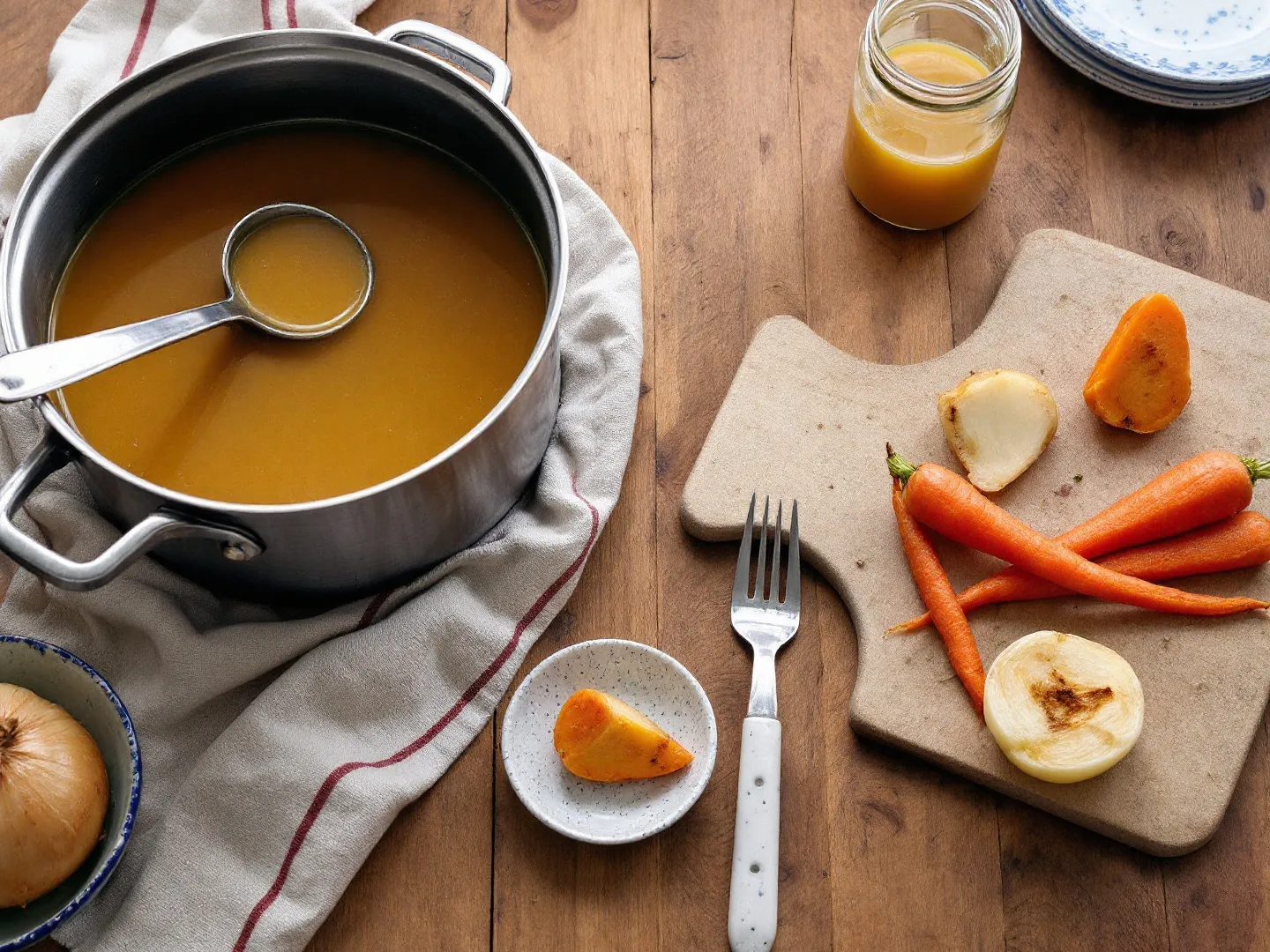
The bones go back in the oven until deep brown, then into a pot of cold water at a lazy simmer for three hours. The house smells like the day after the big dinner, and you end up with ten cups that stretch the feast another day.
The short version
Break up a turkey carcass (or use 4 to 5 pounds of raw wings and backs), roast it with an onion, carrot and celery at 425°F until deep brown, then cover it with cold water and keep it at a lazy simmer for 3 hours. Strain, chill and lift off the fat; don't let it boil hard.
What makes ours better
why ours wins the argument at dinner
-
Roast the bones first. Browning the bones and vegetables gives the stock a deep, roasty color and a flavor that tastes like the bird, not boiled chicken. Scraping the browned bits from the pan into the pot keeps every bit of it.
-
Break up the carcass and use just enough water. Pieces pack tighter than a whole carcass, so you need less water to cover them, and less water means more flavor and body in every cup. Leave some meat and skin on the bones for the same reason.
-
Keep it at a bare simmer and skim. A hard boil churns fat and foam back into the liquid and turns the stock cloudy and greasy. A few lazy bubbles and a quick skim in the first hour keep it clear and clean-tasting.
-
Save the fat. The fat that hardens on top of the chilled stock is pure turkey flavor. Use it in place of some of the butter in your gravy roux, or to sauté the vegetables for soup.
What you need
the stars of the show
- Roast turkey carcass1
- Yellow onion1 large
- Carrot1 large
- Celery rib1
- Parsley stems4
- Fresh thyme3 sprigs
- Bay leaf1
tap each one as it goes in. no double-salting.
Steps
go slow. the good part can’t be rushed.
-
Break up the bones
Heat the oven to 425°F. Pull off any large pieces of meat you want for leftovers, but leave the scraps and some skin on. With kitchen shears or a heavy knife, cut the carcass into 8 to 10 pieces through the backbone and breastbone, and add the wings and any leg bones. If you're using raw wings, cut them at the joints.
-
Roast until deep brown
Spread the bones, onion, carrot and celery in a roasting pan or on a rimmed sheet pan in one layer. Roast, turning everything once halfway through, until the bones and vegetables are well browned at the edges, about 30 minutes for a cooked carcass and 45 minutes to 1 hour for raw wings.
Browned is the goal, not blackened. Burnt bits make the stock bitter.
About 45 min. Cook mode has a timer for this step.
-
Scrape up the pan
Move everything to a large stockpot. Spoon off the fat in the roasting pan, pour in the 1 cup of water and scrape up the browned bits with a wooden spoon (set the pan over a burner if they're stubborn). Pour it all into the pot.
-
Cover with cold water
Add the cold water to the pot, just enough to cover the bones by about an inch; some pieces will float, which is fine. Add the parsley stems, thyme, bay leaf and peppercorns.
-
Bring it up slowly
Bring the pot to a simmer over medium-high heat, then turn it down so only a few small bubbles break the surface. Set the lid on at an angle. For the first hour, skim off the gray foam and some of the fat with a wide spoon every 15 minutes or so.
If it's rolling, it's too hot. Turn it down before it clouds.
-
Simmer 3 hours
Keep it at that lazy simmer for 3 hours in all, adding a splash of water if the bones poke out. It's ready when it's golden brown, smells strongly of roast turkey, and the meat left on a bone tastes like nothing.
About 180 min. Cook mode has a timer for this step.
-
Strain and cool fast
Lift out the big bones with tongs, then pour the stock through a fine-mesh strainer into a large bowl and discard the solids. To cool it quickly, set the bowl in a sink of ice water and stir now and then, or divide it among shallow containers. Refrigerate it once it's no longer steaming, within 2 hours.
-
Lift off the fat
Chill the stock overnight. The fat rises and hardens into a cap you can lift off with a spoon; save it for gravy. Underneath, the stock should be lightly jellied, which means it has body. Salt it when you use it, not now, so it can be reduced for gravy without getting too salty.
Good to know
things I learned the hard way, so you can skip that part
- Making gravy before the turkey's done? Use 4 to 5 pounds of raw wings, backs and necks, which you'll find at most butcher counters in November. Our turkey gravy (recipe) uses a quicker wing stock; a cup or two of this one in place of boxed stock makes it even better.
- No time the night of? Pack the broken-up carcass in a zip-top bag and refrigerate it for up to 3 days, or freeze it for up to 3 months and roast it straight from frozen, adding 10 to 15 minutes.
- For soup, simmer the strained stock with diced vegetables, the picked meat and noodles or rice, and season with salt and a squeeze of lemon at the end.
- If the finished stock tastes thin, simmer it uncovered to reduce it by a quarter, then taste again.
- Storage. Refrigerated in covered containers, 3 to 4 days. Frozen in quart containers or zip-top bags laid flat, up to 4 months. Bring refrigerated stock to a full boil before using it in anything that won't cook for long.
Questions, answered
asked and answered at the kitchen counter
How long should I simmer turkey stock?
About 3 hours at a bare simmer for a carcass or wings. Much less and it tastes thin; much longer and it can turn flat and bitter. When the meat on the bones has no flavor left, it's done.
Do I need to roast the turkey carcass for stock?
No, a carcass that's already been roasted makes a good light stock straight into the pot. Browning it again for 30 minutes gives a deeper color and flavor, which matters most when the stock is going into gravy.
Why is my turkey stock cloudy?
It boiled. Hard bubbling breaks fat into tiny droplets that stay suspended. It tastes fine; next time keep it at a few lazy bubbles and skim early.
Can I leave the turkey carcass out overnight and make stock in the morning?
No. Cooked turkey shouldn't sit at room temperature for more than 2 hours. Break up the carcass, bag it and refrigerate it, and make the stock within 3 days, or freeze it.
Should I add salt to turkey stock?
Not while it cooks. Unsalted stock can be reduced for gravy or sauce without getting too salty. Season the soup or gravy you make with it.
How do I know if my stock has enough gelatin?
Chill it. Stock with good body sets into a loose jelly in the fridge and melts back to liquid when heated. If it stays fully liquid, it will still taste good; next time add a few more wings, backs or necks.
From the table
Made it? Tell me how it went, and who went back for seconds when they thought nobody was looking.
Made it?
stars first, story second. I read every one.
Tap a star
- No reviews yet. Yours would be the first, and I’d read it twice.
Find it in
Published October 26, 2026.