Baking / Loaves & yeast breads
Sourdough Bread
Not rated yet. Be the first.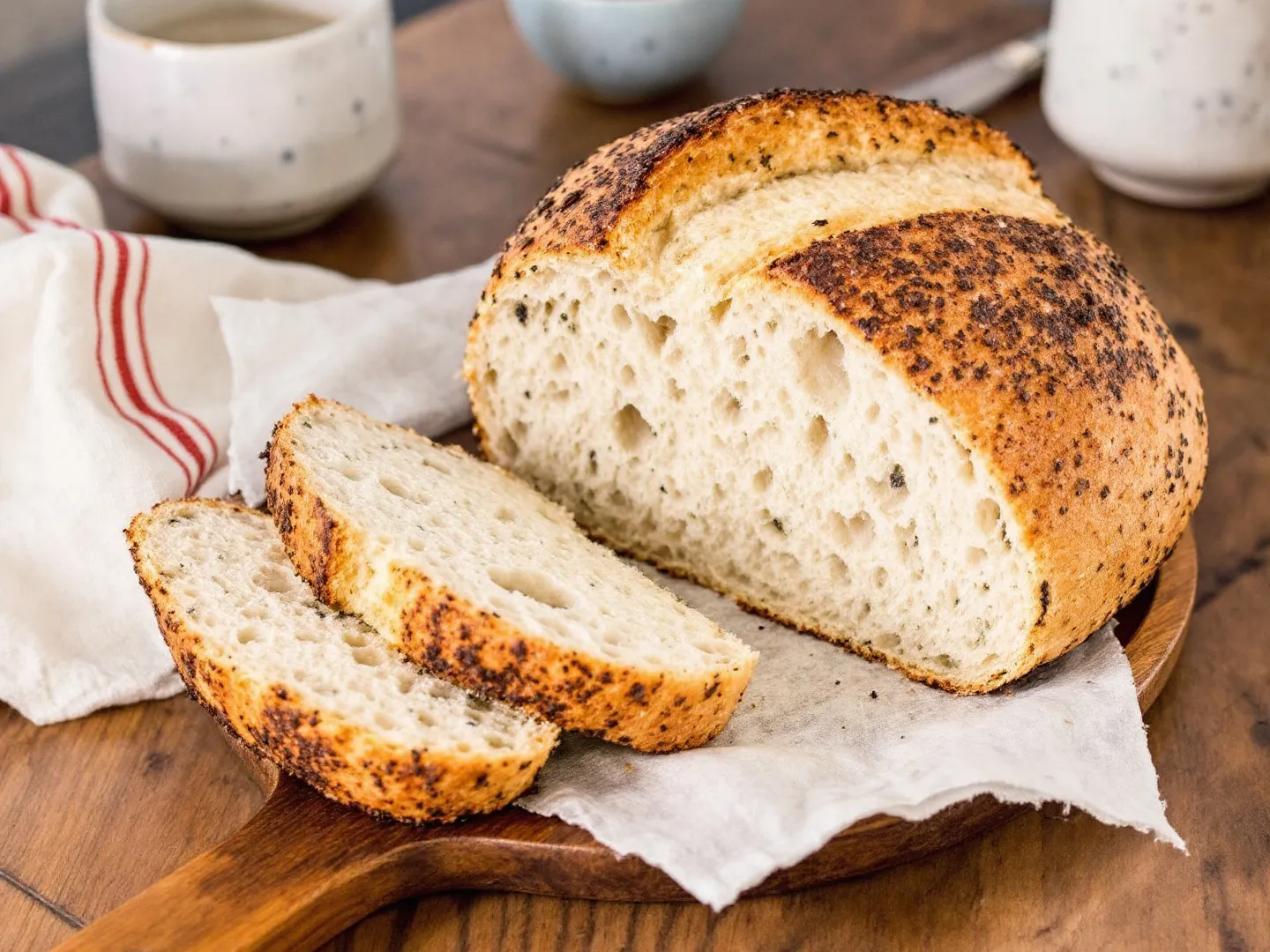
Our first loaf could have anchored a boat. The slow way works better: a ripe starter, a few folds, a night in the fridge, and a hot Dutch oven that makes the crust sing.
The short version
Mix an active starter with water and flour, rest 30 minutes, work in the salt, then fold four times over a few hours. Shape, chill overnight, and bake cold in a preheated Dutch oven at 475°F for 20 minutes covered and 20 to 25 uncovered. Needs a ripe starter.
What makes ours better
why ours wins the argument at dinner
-
Add a little whole wheat flour. About a tenth of the flour as whole wheat feeds the wild yeast and adds a nutty depth, with no change to the method.
-
Rest the flour and water before the salt. A 30-minute rest lets the flour hydrate and starts building gluten before salt tightens it. The dough is easier to handle and needs less work.
-
Proof it cold overnight. The fridge slows the rise and lets flavor build. It also makes the dough firm and easy to score, so the loaf holds its shape and opens cleanly in the oven.
-
Bake in a preheated Dutch oven. The lid traps the steam the dough gives off, which keeps the crust soft long enough for the loaf to spring up. Then you take it off to brown.
yes, all of the butter
Steps
apron on. phone down. mostly.
-
Mix and rest
In a large bowl, stir the starter into the water until it mostly dissolves. Add both flours and mix with a wet hand or a spatula until no dry flour is left. The dough will be shaggy and sticky. Cover with a damp towel and let it rest 30 minutes.
About 30 min. Cook mode has a timer for this step.
-
Work in the salt
Sprinkle the salt over the dough and add a tablespoon of water. With wet fingers, pinch and squeeze the dough for a minute until the salt disappears. Cover and rest 30 minutes.
About 30 min. Cook mode has a timer for this step.
-
Fold the dough
With a wet hand, grab the edge of the dough, stretch it up until it resists, and fold it over the middle. Turn the bowl a quarter turn and repeat, 8 to 12 stretches in all, until the dough tightens into a ball. Cover. Repeat this set of folds 3 more times, resting 30 to 45 minutes between each.
Wet your hands each time. Dough sticks to dry hands and tears when you pull it away.
-
Let it rise until airy
Leave the covered dough alone at 72 to 78°F until it has grown by about half, the top is domed with a few bubbles and the dough jiggles when you shake the bowl, 3 to 5 hours from the first fold. In a cool kitchen it takes longer.
Go by how the dough looks, not the clock. Warm kitchens move faster, cold kitchens slower.
About 240 min. Cook mode has a timer for this step.
-
Shape the loaf
Turn the dough onto a lightly floured counter. Fold the edges into the center to form a round, flip it seam side down, and drag it toward you in short pulls to tighten the surface. Flour a banneton or a towel-lined bowl heavily, set the dough in seam side up, and cover.
-
Chill overnight
Refrigerate the covered dough for 8 to 16 hours. A longer chill gives a stronger sour flavor.
-
Heat the Dutch oven
Put a 5- to 6-quart Dutch oven with its lid in the oven and heat it to 475°F for 30 minutes.
About 30 min. Cook mode has a timer for this step.
-
Score and bake covered
Turn the cold dough out onto a sheet of parchment, smooth side up, and dust with flour. Slash it once, about ½ inch deep, along an arc. Lift it by the parchment into the hot pot, cover, and bake for 20 minutes.
About 20 min. Cook mode has a timer for this step.
-
Uncover and finish
Remove the lid, reduce the oven to 450°F, and bake until the crust is deep brown, 20 to 25 minutes more. The center should read 205°F to 210°F on an instant-read thermometer.
About 22 min. Cook mode has a timer for this step.
-
Cool before slicing
Lift the loaf onto a rack and cool at least 1 hour, ideally 2. Listen for the crackle as the crust cools.
The crumb is still setting inside. Cut it early and it will be gummy.
Good to know
things I learned the hard way, so you can skip that part
- You need a lively starter. If yours is sluggish, feed it twice in a day before mixing. A starter that doubles in 4 to 8 hours and floats in water is ready.
- Weigh the ingredients if you can. Sourdough is sensitive to hydration, and a kitchen scale takes the guesswork out of it.
- Dough too wet to handle? Add flour a tablespoon at a time at the first mix, not later. For a tangier loaf, chill for the full 16 hours.
- For add-ins like seeds or herbs, fold them in during the second set of folds.
- Storage. Cut side down on a board for a day, then in a paper bag for up to 3 days. Sliced and frozen, 3 months; toast from frozen.
Questions, answered
asked and answered at the kitchen counter
Do I need a Dutch oven for sourdough?
It gives the best crust, but a heavy lidded pot or a roasting pan with a lid will do. Without one, bake on a preheated sheet pan with a pan of boiling water on the lower rack.
Why is my sourdough dense and flat?
Most often the starter was not active enough or the dough was under-fermented. Use a bubbly starter that doubled, and let the dough grow by about half before shaping.
How do I know when the bulk rise is done?
The dough has grown by about 50 percent, the top is domed with bubbles at the edges, and it jiggles like set gelatin when you shake the bowl.
Can I bake it the same day without the fridge?
Yes. Let the shaped dough proof at room temperature for 1 to 2 hours until a floured finger leaves a dent that springs back slowly, then bake. The flavor will be milder.
Can I use discard instead of active starter?
Not for the rise. Discard is spent and won't lift the loaf. Save it for sourdough discard pancakes.
From the table
Made it? Tell me how it went, and who went back for seconds when they thought nobody was looking.
Made it?
stars first, story second. I read every one.
Tap a star
- No reviews yet. Yours would be the first, and I’d read it twice.
Find it in
Published October 29, 2026.