How to Make Flaky Pie Crust (By Hand or Food Processor)
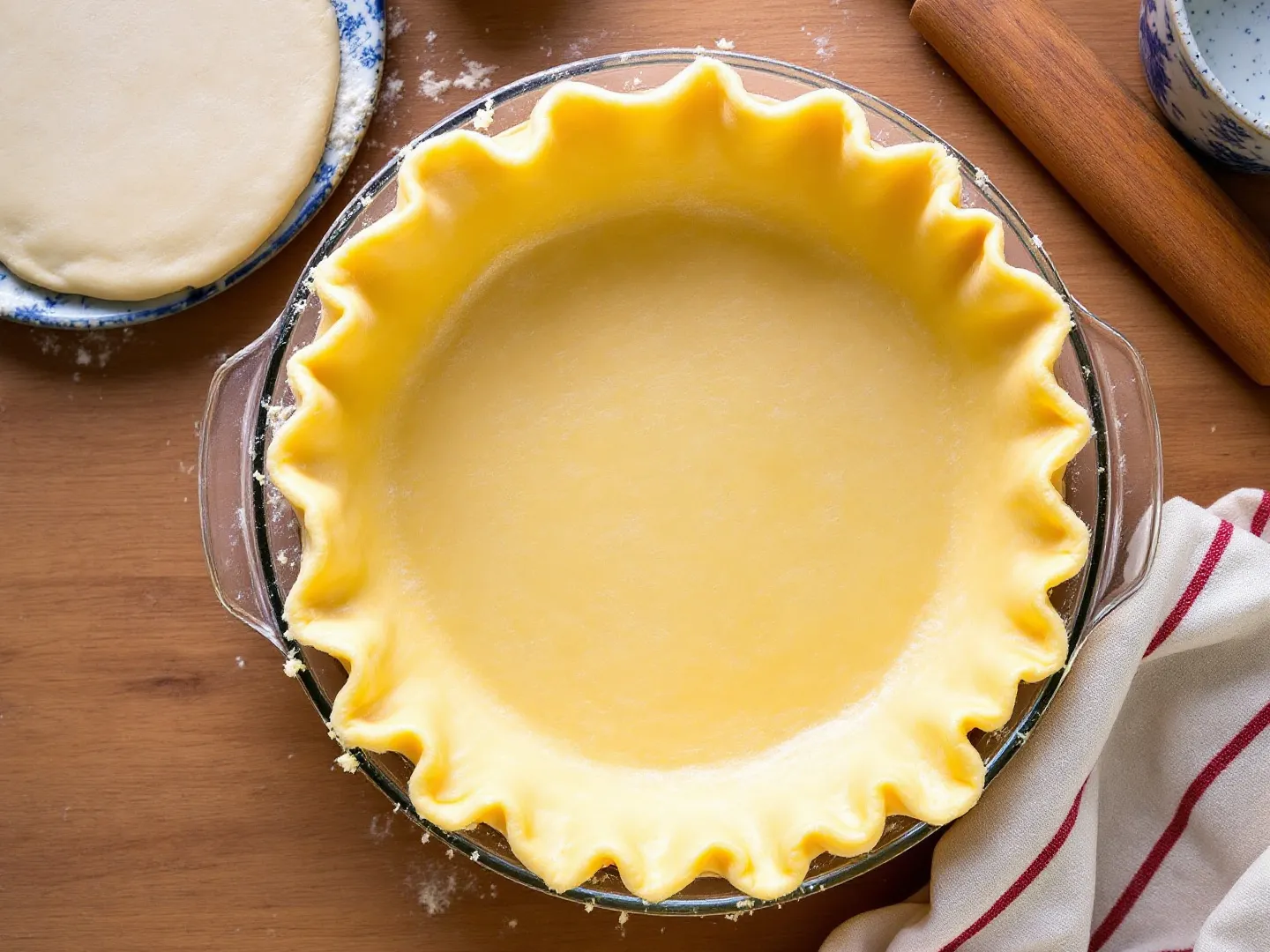
Pie crust has a reputation, mostly spread by people who made it once in July with warm butter. Keep everything cold, stop mixing sooner than feels right, and it behaves like a lamb.
The short version
Work very cold butter into flour and salt until the pieces are the size of peas and flat flakes, then toss in ice water a little at a time just until a handful holds together. Press into a disk, chill at least an hour, and roll from the center out to ⅛ inch. Cold fat and a light hand are the whole trick.
Where the flakes come from
A flaky crust is layers of flour dough with flat pieces of butter trapped between them. In a hot oven the water in that butter turns to steam and pushes the layers apart, and the butter fries them crisp. That's the flake. If the butter melts or gets mashed into the flour before baking, there's nothing to make steam pockets, and the crust bakes up short and crumbly, like a cookie.
The other half is tenderness. Flour plus water plus handling makes gluten, which is great in bread and tough in pastry. Use only as much water as the dough needs, mix briefly, and let it rest so the gluten relaxes.
The ratio
By weight, think 3 parts flour, 2 parts fat, 1 part water (or a little less). For one 9-inch crust that's about 1¼ cups (160 grams) of all-purpose flour, 8 tablespoons (113 grams) of cold unsalted butter, ½ teaspoon salt, 1 teaspoon sugar if it's a sweet pie, and 3 to 5 tablespoons of ice water. Double it for a two-crust pie. Our all-butter pie crust makes two at a time, which is the right number.
All butter tastes best. Swapping a quarter of the butter for cold shortening or lard makes the dough easier to handle and a little more tender, if you want a safety net while you learn. A teaspoon of cider vinegar in the water slows gluten a bit and makes the dough more forgiving.
Mixing, step by step
- Cut the butter into ½-inch cubes and freeze them for 10 to 15 minutes. Put ice in a cup of water so it's truly cold.
- Whisk the flour, salt and sugar in a wide bowl.
- By hand: toss the butter in the flour, then press each cube flat between your fingers, working quickly, until you have a mix of pea-size bits and flat flakes about the size of a dime. A pastry blender or two forks works too. By food processor: pulse the dry ingredients, add the butter and pulse 8 to 10 times, about 1 second each, until the biggest pieces are pea-size. Tip it into a bowl for the next step so you don't overmix.
- Drizzle 3 tablespoons of ice water (no ice) over the flour while tossing with a fork. Squeeze a handful. If it holds together with a few crumbs falling off, it's enough. If it falls apart, add more water 1 teaspoon at a time.
- Turn the shaggy mix onto plastic wrap, gather it into a mound and press it into a disk about 1 inch thick. Visible streaks of butter are exactly right. Wrap it tight.
Resting and rolling
Chill at least 1 hour, or up to 2 days. The flour finishes absorbing the water so the dough rolls without cracking, the gluten relaxes so the crust won't shrink, and the butter firms back up. The disk freezes well for 3 months; thaw it overnight in the fridge.
Let it sit 5 to 10 minutes before rolling if it's rock hard. It should give slightly when pressed. Dust the counter, the top of the dough and the pin lightly with flour. Roll from the center outward, giving the dough a quarter turn every pass or two so it stays round and doesn't stick. Aim for a 12-inch circle about ⅛ inch thick for a 9-inch plate. If the dough turns soft or sticky, slide it onto a baking sheet and chill it 10 minutes. Rolling between two sheets of parchment is a good fix for sticky dough.
Move it by rolling it loosely around the pin and unrolling it over the plate. Lift the edges and let the dough settle into the corners. Don't stretch it; stretched dough shrinks back in the oven. Trim to a 1-inch overhang, fold it under and crimp. Chill the lined plate 30 minutes before filling or baking.
Fixing tears, cracks and other trouble
| Problem | Why | Fix |
|---|---|---|
| Cracks at the edges while rolling | Dough is too cold or a little dry | Let it warm 5 minutes, and pinch cracks closed as they appear |
| A tear or hole | It happens to everyone | Patch with a scrap from the edge and a dab of water, pressed flat. Don't pinch the hole together. |
| Sticks to the counter | Dough is warm or the counter needs flour | Slide a bench scraper under, dust with flour, and chill if it's soft |
| Crumbly and won't hold | Not enough water | Sprinkle on a teaspoon more and fold it in, or patch it in the plate |
| Tough crust | Too much water, too much mixing, or rerolled scraps | Use the squeeze test and roll once if you can |
| Shrinks in the oven | Dough was stretched or not rested | Rest it in the plate 30 minutes and never pull it to fit |
Common mistakes
- Warm butter. Soft butter smears into the flour and you lose the layers. If it looks glossy, chill everything 10 minutes.
- Too much water. A wet, sticky dough makes a hard crust. It should look shaggy and slightly dry when you wrap it.
- Overworking in the food processor. Stop while the butter is still in visible pieces. Finish the water by hand.
- Skipping the rest. Unrested dough fights back, cracks and shrinks.
- Too much flour while rolling. A light dusting is enough. Extra flour dries the crust.
Baking it
For double-crust fruit pies like double-crust apple pie, cherry pie with almond and lemon and blueberry pie with lemon and two thickeners, start hot at 425°F for 20 minutes to set the crust, then drop to 375°F until the filling bubbles through the vents. Bake on a sheet pan on the lowest rack so the bottom browns. If the edges darken early, cover them with a ring of foil. Custard and cream pies need the shell baked first; see how to blind bake a pie crust, which our chocolate cream pie with a silky two-chocolate filling and quiche lorraine with bacon and gruyère both use.
Questions, answered
Butter or shortening for pie crust?
All butter has the best flavor and flake. Replacing a quarter of it with cold shortening makes the dough easier to handle and a bit more tender.
How much water goes in pie crust?
Usually 3 to 5 tablespoons per cup and a quarter of flour. Add it slowly and stop when a squeezed handful holds together.
How long should pie dough rest?
At least 1 hour in the fridge, and overnight is better. It keeps 2 days chilled or 3 months frozen.
Why is my pie crust tough?
Too much water, too much mixing or rerolling scraps. Each one builds gluten. Mix briefly, add water sparingly and roll once.
Published November 9, 2026.